Read a strike rate alongside the innings
Strike rate is runs per 100 balls, which makes it a measure of pace and nothing else. Here is how to calculate it, combine it and read it against the match situation.
By CricketCals · Published 2 October 2026 · Updated 14 October 2026
A score of 42 from 30 balls gives a strike rate of 140.00. That is a pace of 140 runs for every 100 balls faced. It is not a prediction that the batter would have reached 140 if allowed to continue, and it is not the percentage of balls on which they scored.
The number is popular because it is easy to compute and easy to compare. It is also easy to misuse. A short cameo and a long innings can share the same strike rate while doing very different jobs for the team. This guide walks through the arithmetic, shows where the figure hides information, and explains how to read it next to the match situation.
What strike rate measures
Strike rate answers one question: how many runs did the batter score for each ball they faced, scaled to 100 balls so that innings of different lengths line up.
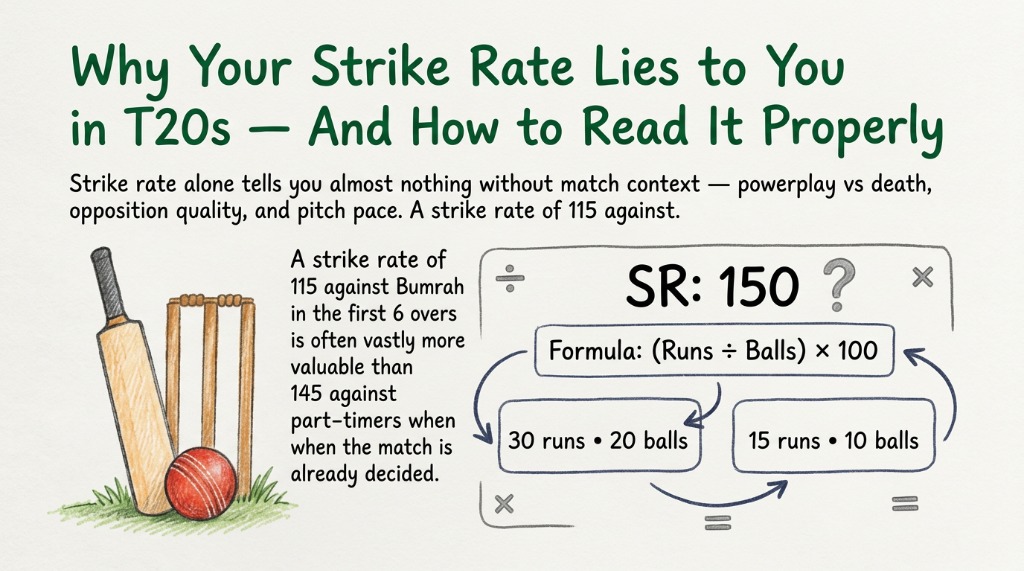
Strike rate = (runs scored ÷ balls faced) × 100
For 42 from 30, divide 42 by 30 to get 1.4 runs per ball, then multiply by 100 for 140.00. One run per ball is a strike rate of 100, two runs per ball is 200, and a batter who scores 15 from 20 balls is on 75.00.
There is no minimum innings length for the calculation, but a very short innings tells you little about a batter's normal pace. Four runs from two balls is a strike rate of 200.00, yet it is far too small a sample to say anything about the player.
Compare it with the asking rate in a chase
In a chase, the team's required run rate is measured in runs per over, while strike rate is runs per 100 balls. You can convert between them. Divide the required rate by six to get runs per ball, then multiply by 100.
| Required rate (runs per over) | Runs per ball | Equivalent strike rate |
|---|---|---|
| 6.00 | 1.00 | 100.00 |
| 7.50 | 1.25 | 125.00 |
| 9.00 | 1.50 | 150.00 |
| 12.00 | 2.00 | 200.00 |
If a side needs 9 an over, the batters at the crease need to score at a combined 150.00 or better for the rest of the chase. A batter on 30 from 25, a strike rate of 120.00, is therefore going slower than the chase needs, even though 120 is a healthy number in isolation. Whether that is a problem depends on wickets in hand and how many balls remain, which the strike rate cannot show. The required run rate calculator handles the team side of the arithmetic.
Use the recorded balls faced
For the denominator, copy the batter's balls-faced figure (BF) from the scorecard. Do not work it out from the team's overs, because the other batter has faced some of those deliveries as well.
Under standard scoring conventions a no-ball counts as a ball faced by the striker while a wide does not. A four hit off a no-ball therefore adds four runs and one ball faced for the batter, plus a no-ball penalty in the team's extras. A wide adds nothing to either of the batter's columns. Some modified competitions change these settings, so check the scoring rules of your event if a published figure looks different from your own count. The guide to cricket extras covers each type in more detail.
Combine innings by adding runs and balls first
For a series or a season, add the runs and the balls before dividing. Scores of 42 from 30 and 18 from 20 give 60 from 50, a combined strike rate of 120.00.
Averaging the two separate rates is a common shortcut and it gives the wrong answer. The individual rates are 140.00 and 90.00, and their simple average is 115.00. That figure treats the 20-ball innings as if it carried the same weight as the 30-ball one. Adding raw totals gives every ball equal weight, which is what a strike rate is supposed to do.
Not-outs do not matter here. A batter who remains unbeaten still has runs and balls faced, and both go into the totals. Not-outs matter for the batting average, which is explained in the batting average guide.
Comparing two batters fairly
Take two fictional batters. Batter A makes 64 from 40 balls, a strike rate of 160.00. Batter B makes 38 from 22 balls, a strike rate of 172.73. On rate alone, B looks quicker.
Now ask what B's innings would have looked like if it had lasted as long as A's. If B had faced another 18 balls and scored only one run per ball, he would have 56 from 40, a strike rate of 140.00, which is below A's. A held a high rate across a much longer innings, and B has not yet shown whether his pace would survive that many deliveries.
That is the practical rule. Compare strike rates between innings of similar length, in the same format, against similar bowling. If the lengths differ a lot, look at runs scored and balls faced alongside the rate rather than in place of it.
Format and phase of the innings
A strike rate of 40.00 would be unusually low in a T20 innings and unremarkable in a Test. A batter who scores 40 from 100 balls on a difficult pitch while their partner scores freely at the other end may be doing exactly the job the team needs. The same figure in a short chase would be a serious problem.
Phase matters as well. Early overs with the field spread and a hard ball are different from middle overs against spin, and different again from the last five overs when batters can take more risk. When you read a single strike rate for a whole innings, you are averaging across all of these. Labels such as "aggressive" or "cautious" are broad prompts for interpretation, not verdicts on a player. See the guide to scoring across formats for how format rules change the arithmetic.
Practice questions with answers
Try these on your own first, then compare with the answers.
Question 1. A batter makes 68 from 44 balls. What is the strike rate?
Answer. 68 ÷ 44 × 100 = 154.55.
Question 2. A pair needs 45 from 24 balls. What strike rate must they achieve together, and what is that per over?
Answer. 45 ÷ 24 × 100 = 187.50, which is 45 × 6 ÷ 24 = 11.25 runs per over.
Question 3. A batter scores 24 from 18 balls and then 36 from 22 balls in the next match. What is the combined strike rate?
Answer. Add first: 60 from 40 balls gives 150.00. Averaging the two separate rates (133.33 and 163.64) would give 148.48, which is wrong.
Check your own figures
Enter any runs and balls-faced pair from a scorecard and the calculator returns the strike rate, runs per ball and a broad pace label.
Open the Batting Strike Rate calculatorQuestions readers ask
Can strike rate be calculated with zero balls faced?
No. Dividing by zero leaves the rate undefined. Zero runs from a positive number of balls is valid and gives 0.00, but a batter who has not yet faced a ball has no strike rate.
Do I include extras in the runs figure?
No. Use only the runs credited to the batter. Byes, leg-byes, wides and no-ball penalties go to the team extras, not to the individual batter.
Is a higher strike rate always better?
No. It describes pace, not value. A fast 20 that ends the innings early can hurt the team, and a slow 60 that anchors a chase can win it. Read the figure with wickets, format and match situation.
What is the difference between strike rate and batting average?
Strike rate is runs per 100 balls faced. Batting average is runs per dismissal. They answer different questions, so a good batter is usually judged on both together.
How this guide was checked
Published by CricketCals. Every match, score and player in this guide is a fictional teaching example, so you can reproduce each answer from the figures shown. Calculations keep full precision until the final rounding. If a published scorecard or a competition rule disagrees with a figure here, the official record and the event's playing conditions take priority. You can send a correction with the figures and the rule you used.
- MCC Laws of Cricket: Laws 18, 21, 22 and 23 cover how runs are credited and how extras are recorded.
- ICC playing conditions: Competition rules can modify scoring settings; use the document for your event.