T20, ODI and Test: what changes when you calculate cricket numbers
The formulas are the same in every format, but the context changes what the numbers mean. This guide compares T20, one-day and Test cricket and shows which calculations matter most in each.
By CricketCals · Published 14 October 2026 · Updated 14 October 2026
Strike rate, economy rate and run rate are calculated the same way in every format. A run is a run and an over is six balls. What changes is how many balls a side has, what restrictions apply, and which numbers a team actually cares about. A strike rate of 100 is unremarkable in a one-day innings and very slow in a T20, and in a Test it can be extremely fast.
This guide compares the three main formats and points to the calculators that matter most in each.
The formats side by side
| Feature | T20 | One-day (ODI) | Test |
|---|---|---|---|
| Overs per innings | 20 | 50 | No limit in an innings |
| Balls available | 120 | 300 | Not fixed |
| Maximum overs per bowler | 4 | 10 | None |
| Fielding restrictions | Overs 1 to 6 (two outside the circle), then five | Phased across the innings | None of this kind |
| Result | Win, tie or no result | Win, tie or no result | Win, draw or tie |
| Most useful statistics | Strike rate, economy, run rate | Run rate, strike rate, average | Average, bowling strike rate, balls per dismissal |
These are the standard international conditions. Domestic and club competitions often vary the details, so confirm the rules for your own event. Overs per bowler and fielding restrictions are set by the playing conditions, which is why the details in this article should be checked against your event’s regulations.
T20: every ball is worth more
With only 120 balls, a dot ball is a larger share of the innings and rates are higher. Required run rates in chases often sit above 8 an over, and phases matter a great deal, as described in the T20 phases guide. Strike rate and economy carry the most weight. A bowler is capped at four overs, so economy over a four-over spell is the headline figure.
A strike rate of 150 means 1.5 runs per ball, or 9 runs per over. Compare that with the required rate before deciding whether a batter is ahead or behind.
One-day cricket: building and accelerating
Fifty overs gives a side time to build an innings, and the batting order is built around that. Run rates of five or six an over are common in the middle phase, with acceleration at the end. Average and strike rate both matter, because a batter who survives is valuable only if they also score quickly enough. The batting average guide shows how the two combine as balls per dismissal.
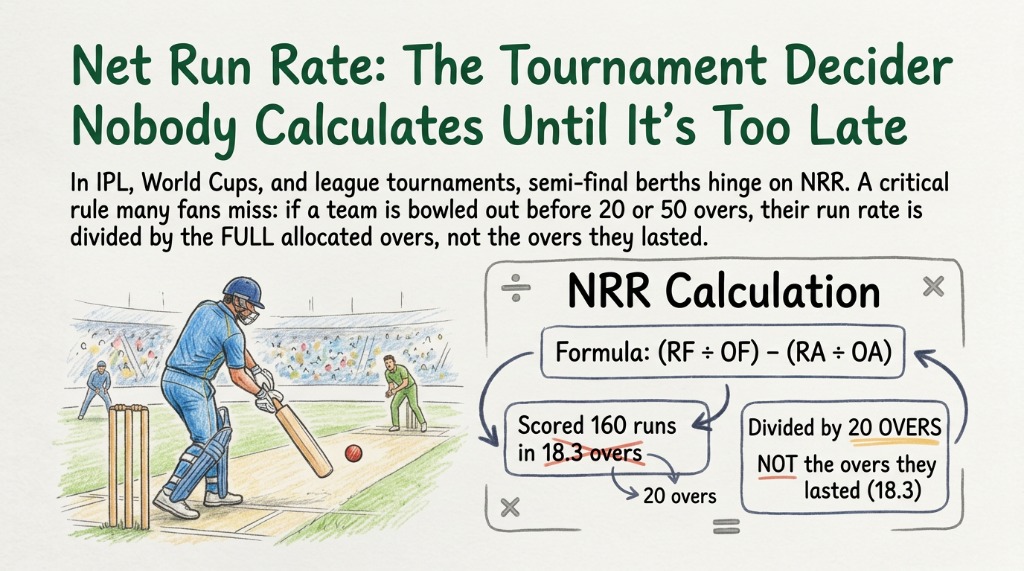
Net run rate matters in tournament tables, and the net run rate guide explains how it is calculated, including the all-out rule.
Test cricket: wickets over runs
A Test side must bowl the opposition out twice to win, so bowling average and bowling strike rate matter more than economy. Batters’ averages and balls faced per dismissal measure durability. Run rates of around three an over are normal, which in strike-rate terms is 50. That is slower than limited-overs cricket by design, because the batting side is trying to avoid losing wickets over several days.
There is no over limit in an innings, so a required run rate is not defined in the same way. Equations built around overs remaining, such as the required rate, do not apply until the final stage of a match with a target.
Rain and revised targets
Limited-overs matches that lose time to rain use a resource-based method to set a new target, as explained in the DLS guide. Tests are not adjusted this way. Lost time simply reduces the number of overs available, which can turn a close game into a draw.
Which calculator for which format
- T20: strike rate, economy and required run rate.
- ODI: run rate, net run rate and partnership.
- Test: batting average and bowling average and strike rate.
- Any format: overs to balls for converting scorecard notation.
Practice questions with answers
Try these on your own first, then compare with the answers.
Question 1. A T20 side is scoring at 8.5 an over. What strike rate does that equal?
Answer. 8.5 × 100 ÷ 6 = 141.67 runs per 100 balls.
Question 2. A Test side scores 270 in 90 overs. What is the run rate?
Answer. 270 ÷ 90 = 3.00 an over, equal to a strike rate of 50.
Question 3. What is the maximum number of balls a bowler can deliver in standard T20 and ODI cricket?
Answer. Four overs is 24 balls in T20 and ten overs is 60 balls in an ODI, in standard international conditions.
Check your own figures
Pick the calculator that fits your format. Every tool uses six-ball overs and explains its assumptions.
Browse all calculatorsQuestions readers ask
Do the formulas change between formats?
No. Strike rate, economy and run rate use the same formulas in every format. What changes is the number of balls available and how the figures are interpreted.
How many overs can one bowler bowl?
In standard international cricket, four in T20 and ten in one-day cricket. There is no limit in Tests. Other competitions may differ.
Is a strike rate of 100 good?
It depends on the format and the situation. It is a run a ball, which is slow in T20, steady in one-day cricket and fast in a Test.
Does the six-ball over apply everywhere?
It applies in most professional cricket. Some competitions, such as The Hundred, use different formats. The calculators on this site assume six-ball overs.
How this guide was checked
Published by CricketCals. Every match, score and player in this guide is a fictional teaching example, so you can reproduce each answer from the figures shown. Calculations keep full precision until the final rounding. If a published scorecard or a competition rule disagrees with a figure here, the official record and the event's playing conditions take priority. You can send a correction with the figures and the rule you used.
- ICC playing conditions: Standard conditions for each international format.
- MCC Laws of Cricket: The Laws apply across formats; conditions modify them.