A rain target is about resources, not an overs ratio
When rain cuts a match, overs and wickets both change what a team can score. This guide explains the resource idea behind DLS and works through the arithmetic with simplified numbers.
By CricketCals · Published 2 October 2026 · Updated 14 October 2026
If a 50-over chase is cut to 40 overs, it is tempting to multiply the first-innings score by 40 ÷ 50 and call that the new target. It feels fair, and it is wrong. The batting side lost more than ten overs of scoring time: it lost the overs at the end of the innings, when batters can attack with wickets in hand, and it may also have lost wickets.
The Duckworth-Lewis-Stern method, usually shortened to DLS, tries to measure what a team has left to bat with. This guide explains the central idea in plain language and works through the arithmetic with deliberately simplified numbers.
Resources combine overs and wickets
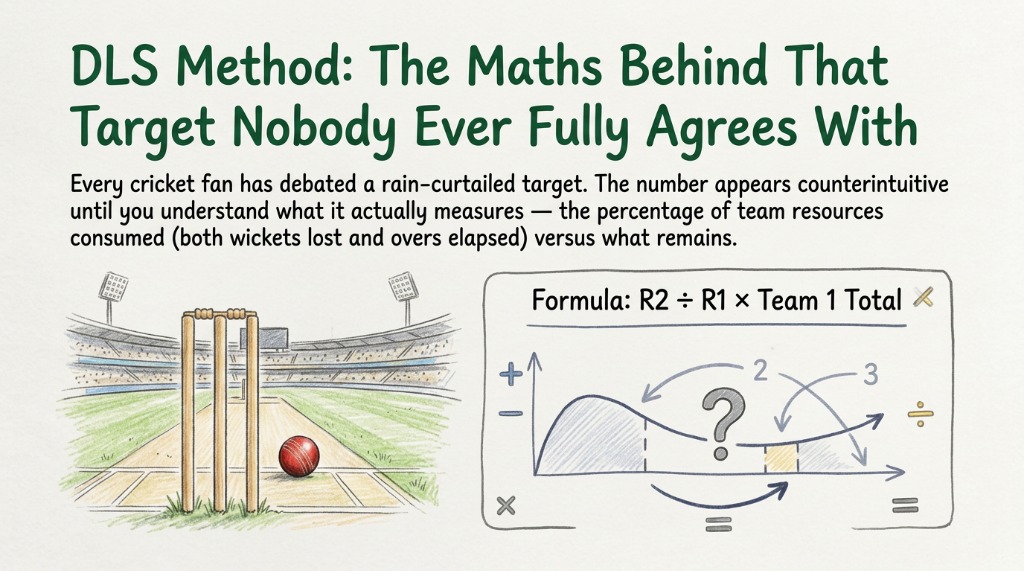
DLS treats a batting side as having a percentage of its full scoring resources available. A team at the start of a full innings has 100%. As overs are used and wickets fall, the percentage drops. Two things sit inside that number.
- Overs remaining. More overs mean more opportunity to score.
- Wickets in hand. With more wickets left, batters can take more risk, so the same number of overs is worth more.
The consequence is that overs and wickets cannot be separated. Ten overs left with nine wickets in hand is worth much more than ten overs left with three wickets in hand. A plain ratio of overs ignores that entirely.
The resource percentages used in official calculations come from a published table or from software. The numbers in this guide are illustrative only. They are chosen to make the arithmetic easy to follow and are not lookups for any particular number of overs.
When the chasing side has fewer resources
Imagine Team 1 completes its innings and scores 250 using 100% of its resources. Because of rain, Team 2 is allocated only 80%.
Par score = Team 1 score × Team 2 resources ÷ Team 1 resources
250 × 80 ÷ 100 = 200. That is the par score: the total Team 2 would be level with at the end of its reduced innings. To win, Team 2 needs one more, so the target is 201. When the result is not a whole number, take the whole-number part and add one. A par of 212.5 gives a target of 213, not 212.5 rounded in some other way.
Notice how this differs from the overs ratio. Cutting an innings to 40 overs and applying 40 ÷ 50 to 250 gives 200 as well, but only by coincidence of the numbers chosen. In a real match, 40 overs with all ten wickets in hand is worth a different share of the innings than 80%, and the table decides what that share is.
An interruption in the middle of a chase
Most rain interruptions happen during the chase, not before it. The key step is to work out how much was lost, not how much remains.
- Find the resources remaining at the moment play stopped. Say 60% in this simplified example.
- Find the resources remaining when play restarts with fewer overs. Say 45%.
- Subtract: 60% − 45% = 15% lost.
- Team 2's total resources become 100% − 15% = 85%.
- Apply the par formula: 250 × 85 ÷ 100 = 212.5, so the target is 213.
Do not replace the whole innings allocation with the resources remaining after the restart. The overs already used and the runs already scored still count; only the difference caused by the interruption is removed.
When the target can go up
Rain does not always lower the target. If the first innings is shortened and the chasing side is then given a full allocation of overs, Team 2 has more resources than Team 1 did. DLS then adds a share of an average full-innings score, a parameter called G50 in the method, rather than scaling Team 1's total down. The target ends up higher than Team 1's score plus one.
The reason is straightforward. If Team 1 batted fewer overs and scored 150, a chasing side that gets more overs than that has had a bigger opportunity and should be asked for more than 151. The exact additional runs depend on the G50 setting for the edition in use and the gap in resources, so this guide does not attempt a number.
Par score and target are different questions
A revised target is the score needed to win at the end of the reduced innings. A par score is the score that would leave the match tied at a given point if play could not continue. If play stops for good before the chasing side has faced its allocation, the team ahead of par wins and the team behind loses. Level with par is a tie.
The two numbers are one run apart in most situations, which is why they are sometimes confused. When a broadcaster says "par is 112", the team needs 113 to win if play ended at that moment. When the match is going to resume, officials announce the revised target, not the par score.
After the target is announced, the arithmetic is ordinary
Once officials publish a revised target and the overs available, everything else is normal chase arithmetic. If the revised target is 131, the team is on 96 and 24 balls remain, it needs 131 − 96 = 35 more runs. The required rate is 35 × 6 ÷ 24 = 8.75 per over.
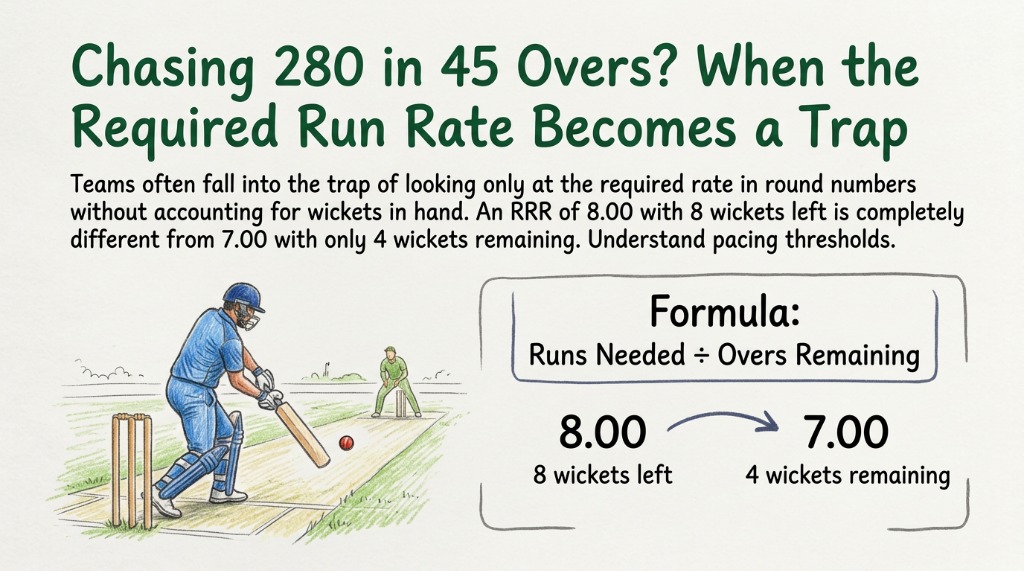
You can check this with the required run rate calculator, and the required run rate guide explains how the figure changes ball by ball. DLS only decides the target and the number of overs; it does not change how the required rate is calculated.
What a simplified estimator cannot do
The estimator on this site uses a historical Standard Edition style resource table with interpolation. It assumes Team 1 had its full scheduled resources and models a single reduction for Team 2. It does not cover earlier interruptions, an interrupted first innings or the extra rules in some competitions. No one-run or two-run accuracy is promised.
Official matches use the method and software chosen by the event. Professional-level and international matches use the Professional Edition, which also reflects how fast teams have been scoring. The Standard Edition uses a table. For any real decision, use the target announced by the match officials.
Practice questions with answers
Try these on your own first, then compare with the answers.
Question 1. Team 1 scores 240 using 100% of its resources. Team 2 is allocated 75%. What is the par score and the target?
Answer. 240 × 75 ÷ 100 = 180, so par is 180 and the target is 181.
Question 2. Same first innings, but Team 2 is allocated 82%. What is the target?
Answer. 240 × 82 ÷ 100 = 196.8. Take the whole-number part, 196, and add one: 197.
Question 3. With a revised target of 181, a team is on 120 with 18 balls left. What is the required rate?
Answer. Runs needed are 181 − 120 = 61. The rate is 61 × 6 ÷ 18 = 20.33 per over, which is very demanding.
Check your own figures
The estimator on this site uses a simplified resource table to show how a revised target moves when overs are lost. It is a learning tool, not an official calculation.
Open the DLS Target calculatorQuestions readers ask
Why not just scale the target by the overs left?
Because overs are not worth the same at every stage of an innings, and wickets in hand change what a team can do with its overs. A plain ratio ignores both.
Does DLS favour the team batting second?
The method aims to be neutral. Results in individual matches can look unfair to supporters, but the calculation treats both innings by the same resource logic.
Is the DLS Target calculator on this site official?
No. It is a simplified learning tool. Use the target and overs announced by the match officials for any real match.
What does DLS stand for?
Duckworth-Lewis-Stern, named after the statisticians who developed and later maintained the method.
How this guide was checked
Published by CricketCals. Every match, score and player in this guide is a fictional teaching example, so you can reproduce each answer from the figures shown. Calculations keep full precision until the final rounding. If a published scorecard or a competition rule disagrees with a figure here, the official record and the event's playing conditions take priority. You can send a correction with the figures and the rule you used.
- ICC: Duckworth-Lewis-Stern: Background on the method and how it is applied in ICC events.
- ICC playing conditions: Event-specific conditions describe when and how DLS applies.