Why averaging match run rates can mislead
Net run rate compares how fast a team scores with how fast it concedes across a whole competition stage. Here is how to calculate it, including the all-out and chase adjustments.
By CricketCals · Published 2 October 2026 · Updated 14 October 2026
Net run rate, usually written NRR, decides more league tables than most supporters expect. When two teams finish level on points, the one that has scored faster and conceded slower across the tournament goes through. It is a single number built from many matches, and the most common error is to calculate it match by match and average the results.
This guide gives the formula, explains the two adjustments that trip people up, and works through a three-match example with an all-out innings and a quick chase.
The formula
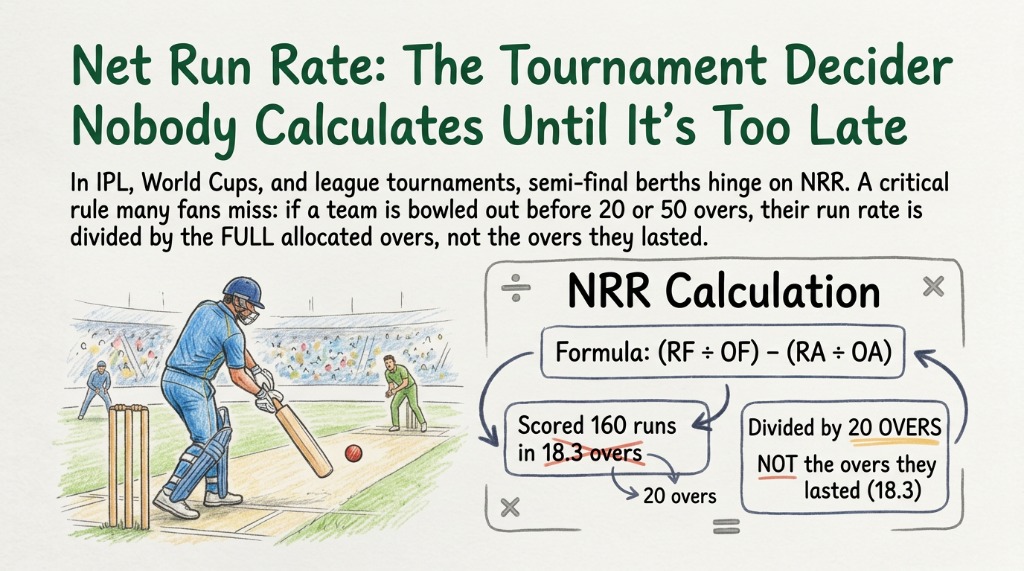
NRR = (total runs scored ÷ total overs faced) − (total runs conceded ÷ total overs bowled)
Each part is an aggregate over the matches the competition counts. Add up every run the team scored and every over it faced, then divide. Do the same for runs conceded and overs bowled. Subtract the second rate from the first. A positive result means the team has scored faster than it has conceded.
NRR is quoted to three decimal places in most tables, such as +0.704 or −1.215. Overs must be converted from scorecard notation into balls or decimal overs before the division, because 16.4 overs is 100 balls, not 16.4 decimal overs.
Why you cannot average the matches
Consider two completed 20-over matches. Your side scores 160 in 20 overs, then 121 in 15 overs. The opposition scores 150 in 20 and 120 in 20. Aggregate totals give:
- Scoring rate: (160 + 121) ÷ (20 + 15) = 281 ÷ 35 = 8.029
- Conceding rate: (150 + 120) ÷ (20 + 20) = 270 ÷ 40 = 6.750
- NRR: 8.029 − 6.750 = +1.279
Now average the separate match NRRs. Match one is 8.00 − 7.50 = +0.500. Match two is 8.067 − 6.000 = +2.067. Their average is +1.283. That is close but not equal, and the gap can be large when the innings lengths differ a lot. The second match used only 15 overs, so it should carry less weight in the scoring rate, and the aggregate calculation does that automatically.
The all-out rule
If a team is bowled out before using its full quota of overs, the innings is counted as if it had faced the full quota for NRR. In a 20-over match, 100 all out in 15 overs contributes 100 runs and 20 overs, a rate of 5.00. It does not contribute 100 runs and 15 overs, which would be 6.67. The adjustment goes in the denominator only. No runs are added.
The reason is fairness. A team that loses all ten wickets has not made efficient use of its overs, and the rule stops it from boosting its rate by failing quickly. The same rule applies to the opponents: if you bowl a side out, you are credited as having bowled the full quota against them.
A chasing side that reaches its target uses the balls it actually took. Chasing 150 in 16.2 overs (98 balls) gives a scoring rate of 150 × 6 ÷ 98 = 9.18. Had the same side needed all 20 overs, its rate would be 7.50. That is why a fast win helps NRR so much.
A three-match example
Here are three fictional 20-over matches for one team, with the rule adjustments applied.
| Match | Runs scored | Overs counted (faced) | Runs conceded | Overs counted (bowled) |
|---|---|---|---|---|
| 1 | 170/5 | 20.0 | 150/9 | 20.0 |
| 2 | 120 all out in 17.3 | 20.0 (all out) | 121/3 in 16.2 | 16.2 (98 balls) |
| 3 | 190/4 | 20.0 | 140 all out in 18.4 | 20.0 (all out) |
| Total | 480 | 60.0 | 411 | 56.3 (338 balls) |
Scoring rate: 480 ÷ 60 = 8.000. Conceding rate: 411 × 6 ÷ 338 = 7.296. NRR = 8.000 − 7.296 = +0.704.
In match two the team's own all-out innings was counted as 20 overs, even though it lasted 17.3, but the opponent's chase counts as the 98 balls they actually used. Both adjustments appear in the same match.
Rain, no-results and tie-breaks
Rain-affected matches, abandoned matches and Super Overs need the competition's own rules. Some events use the revised targets and overs from the interruption, some exclude no-result matches entirely, and some leave Super Overs out of NRR. Check the playing conditions of your event before trying to reproduce an official table. This site's DLS guide explains how revised targets arise, but it cannot say how each tournament applies them to NRR.
Most leagues rank teams on points first and use NRR to separate teams that are level on points. Some add earlier tie-breaks such as head-to-head results. If your league does something different, its regulations decide.
Auditing a table
To check a published NRR, build a worksheet with one row per innings. Record runs, overs counted and a note of which adjustment applied. Total each column, convert overs to balls, then calculate both rates. If your result differs from the published one by a small amount, the likeliest causes are a missed all-out adjustment, an over entered as a decimal, or a match the competition excluded.
For batting and bowling figures that feed into NRR, see the run rate calculator and the guide to reading a scorecard.
Practice questions with answers
Try these on your own first, then compare with the answers.
Question 1. A team scores 150 in 20 overs and concedes 140 in 20 overs in one match. What is its NRR?
Answer. 150 ÷ 20 − 140 ÷ 20 = 7.50 − 7.00 = +0.500.
Question 2. A team is all out for 90 in 14.2 overs of a 20-over innings. What scoring rate counts for NRR?
Answer. The full quota is used: 90 ÷ 20 = 4.50. Using the overs actually faced (86 balls) would wrongly give 6.28.
Question 3. Match one: the team scores 180 in 20 overs and concedes 160 in 20. Match two: it is all out for 100 and concedes 101 for 2 in 12 overs. What is the NRR?
Answer. Scored: 180 + 100 = 280 in 20 + 20 = 40 overs, a rate of 7.000. Conceded: 160 + 101 = 261 in 20 + 12 = 32 overs, a rate of 8.156. NRR = 7.000 − 8.156 = −1.156.
Check your own figures
Add each match with runs, overs and an all-out flag and the calculator applies the full-quota rule and returns the aggregate NRR.
Open the Net Run Rate calculatorQuestions readers ask
Does a big win always improve NRR?
Not by itself. A big win helps if it comes with high runs or a fast chase, and the margin matters in the way runs and overs enter the formula. Wins by few runs add little.
Why does an all-out innings use the full overs?
So a team cannot improve its rate by being bowled out quickly. The full allocation is counted in the denominator while the runs stay as scored.
Is NRR calculated per match?
No. It is calculated from totals across all counted matches. Averaging individual match figures gives a different answer.
How many decimal places should I use?
Keep full precision during the calculation and round the final NRR to three decimal places, as most tables do.
How this guide was checked
Published by CricketCals. Every match, score and player in this guide is a fictional teaching example, so you can reproduce each answer from the figures shown. Calculations keep full precision until the final rounding. If a published scorecard or a competition rule disagrees with a figure here, the official record and the event's playing conditions take priority. You can send a correction with the figures and the rule you used.
- ICC playing conditions: Event conditions include net run rate provisions and the all-out rule.
- MCC Laws of Cricket: Law 17 defines the over used in the calculation.