A quiet over changes the asking rate: work it through
The asking rate in a chase moves with every ball. This guide works through a 20-over chase step by step so you can recalculate it yourself from the score and balls left.
By CricketCals · Published 2 October 2026 · Updated 14 October 2026
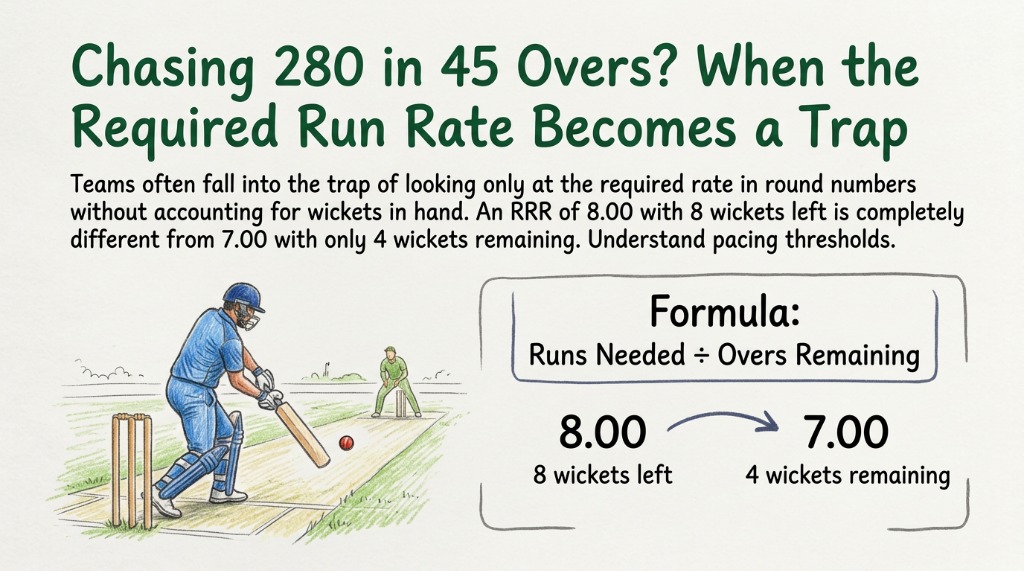
Every chase comes down to one question: how fast do the batters need to score from here? The answer is the required run rate, sometimes called the asking rate. It changes after every ball, and the way it changes surprises people. A decent-looking over of ten runs can still make the chase harder.
This guide works through a single 20-over chase, over by over, so you can see how the figure is built and how to recalculate it from the score and the balls left.
Start with the target to win
Use the target to win, not the first-innings score. If the opposition made 179, an uninterrupted chase needs 180 to win and 179 to tie. Subtract the current score from 180 to find the runs needed.
Required run rate = runs needed × 6 ÷ balls remaining
Working in balls keeps the arithmetic honest. A 20-over innings has 120 legal balls. After 13 overs, 78 have been used and 42 remain.
A chase worked through
At 108 after 13 overs, the side needs 180 − 108 = 72 from 42 balls. The required rate is 72 × 6 ÷ 42 = 10.29. Their current rate is 108 ÷ 13 = 8.31, so there is a gap of almost two runs per over to close. Equivalently, they need about 1.71 runs from each ball.
Now the next over arrives. Here is what three different outcomes do to the requirement.
| Runs scored in the over | New score | Runs needed | Balls left | New required rate |
|---|---|---|---|---|
| 3 | 111 | 69 | 36 | 11.50 |
| 10 | 118 | 62 | 36 | 10.33 |
| 12 | 120 | 60 | 36 | 10.00 |
Three runs off the over pushes the rate up to 11.50. Ten runs sounds productive but leaves the requirement fractionally higher than before, at 10.33 against the 10.29 the batters started the over on. It takes twelve runs to bring the rate down to 10.00 and make real progress.
Always recalculate from the new score and the new balls remaining. Do not try to adjust the previous rate by subtracting the runs scored, because the balls remaining change at the same time.
Ball by ball: dots, wides and boundaries
Within an over, each delivery changes the arithmetic in its own way.
- A dot ball uses a ball and adds no runs. From 72 needed off 42 balls, a dot leaves 72 off 41, a rate of 10.54.
- A wide adds a run to the score and does not use a legal ball. The requirement becomes 71 off 42, or 10.14.
- A single reduces the runs needed by one and the balls by one.
- A boundary reduces the runs needed by four or six while using one ball.
Because every legal ball removes one from the denominator, a dot has a larger effect when few balls remain. Eight dots in the first ten overs of a chase matter much less than two in the last over.
Wickets do not appear in the formula
A fallen wicket can make a chase feel harder, and it usually is harder, but the required rate calculation does not include it. Only the runs needed and the balls available enter the figure. A wicket on a legal ball uses a ball like any other.
This is why a required rate of 8.00 can be comfortable with eight wickets in hand and difficult with two. The number tells you what has to be scored, and the wickets in hand tell you how realistic it is. A projected-total calculation that blends the two is covered in the projected score guide.
Edge cases worth knowing
- Target reached. Once the score passes the target, no further rate is needed.
- No balls left. If no balls remain and runs are still needed, a finite rate cannot be calculated.
- Overs in notation. At 13.2 overs of a 20-over innings, 80 balls have been used and 40 remain. Subtract balls, not decimals.
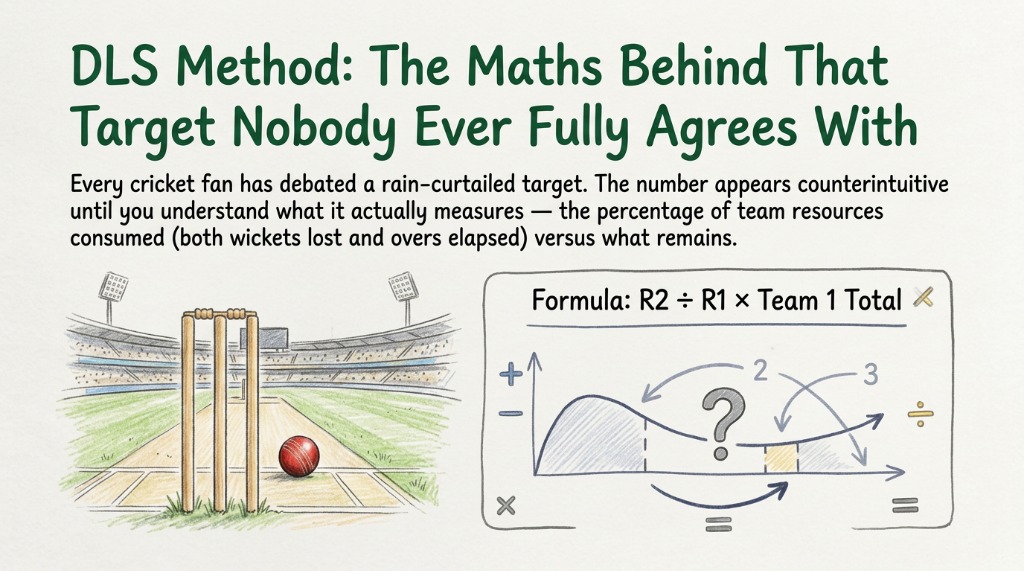
- Revised targets. After a rain interruption the target and the number of overs change. Use the figures announced by the officials, as explained in the DLS guide.
For a quick estimate of where an innings is heading at its current rate, a team on 108 after 13 overs is scoring 8.31 an over. At that pace it would add about 58 more runs in the seven overs left and finish near 166, well short of 180. That is a projection, not a prediction: it assumes nothing changes.
Practice questions with answers
Try these on your own first, then compare with the answers.
Question 1. The opposition made 154. A side is 62 after 8 overs of a 20-over chase. What is the required rate?
Answer. Target 155. Runs needed 93, balls left 72. 93 × 6 ÷ 72 = 7.75.
Question 2. The next over produces 11 runs, so the score is 73 after 9 overs. What is the new required rate?
Answer. Needed 82 from 66 balls: 82 × 6 ÷ 66 = 7.45.
Question 3. A side needs 40 from 3.4 overs. What rate is required?
Answer. 3.4 overs is 22 balls. 40 × 6 ÷ 22 = 10.91 per over.
Check your own figures
Enter the target, the current score and the overs bowled to get the current rate, the required rate and a what-if table for the next over.
Open the Required Run Rate calculatorQuestions readers ask
What is the difference between required run rate and current run rate?
Current run rate is runs scored per over so far. Required run rate is runs still needed per over from here. Compare the two to see how far ahead or behind the chase is.
Does a wide reduce the balls remaining?
No. A wide adds a run and is not a legal delivery, so the runs needed fall by one while the balls remaining stay the same.
How do I enter 13.2 overs?
Use scorecard notation: 13.2 means 13 complete overs and 2 balls, which is 80 balls. The calculator converts this for you.
Is a required rate above 10 impossible?
No. It describes difficulty, not impossibility. Teams chase higher rates with wickets in hand, but the margin for dot balls becomes very small.
How this guide was checked
Published by CricketCals. Every match, score and player in this guide is a fictional teaching example, so you can reproduce each answer from the figures shown. Calculations keep full precision until the final rounding. If a published scorecard or a competition rule disagrees with a figure here, the official record and the event's playing conditions take priority. You can send a correction with the figures and the rule you used.
- MCC Laws of Cricket: Laws 17 and 22 cover the over and wides.
- ICC playing conditions: Match conditions for the event you are following.