Ten common cricket calculation mistakes and how to avoid them
Most cricket calculation errors come from the inputs, not the formulas. These ten mistakes account for most wrong answers, and each one has a simple fix.
By CricketCals · Published 14 October 2026 · Updated 14 October 2026
When a cricket calculation gives a strange answer, the formula is rarely at fault. The cause is nearly always the figure that went in: overs entered as decimals, team runs used in place of bowler runs, or a time window that does not match. This checklist covers the ten mistakes we see most often, with a worked example and the fix for each.
1. Treating overs as a decimal
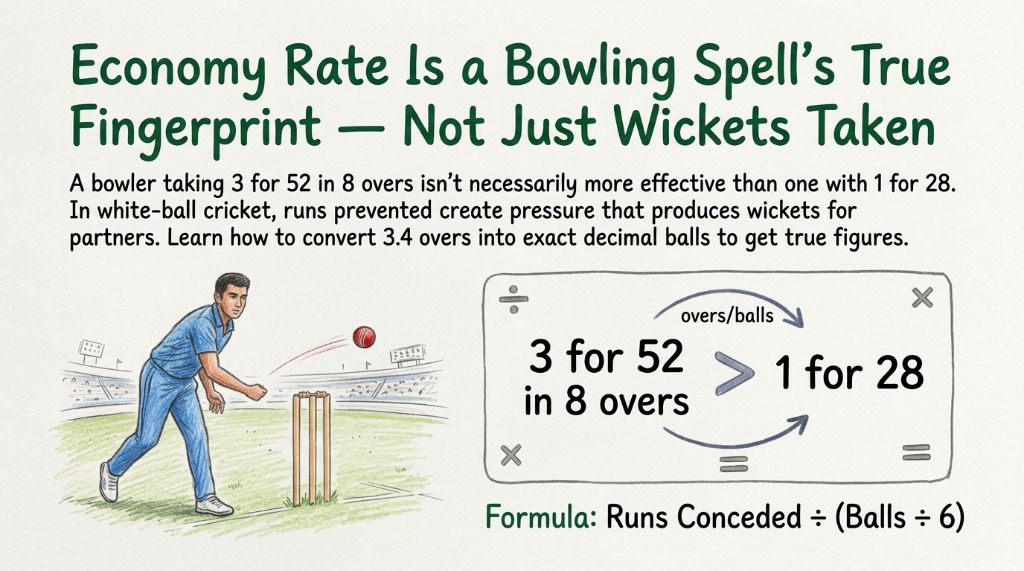
Scorecard overs are not decimals. 8.3 overs is 8 × 6 + 3 = 51 balls. A team on 60 runs has a run rate of 60 × 6 ÷ 51 = 7.06. Dividing 60 by 8.3 gives 7.23, which is wrong. Fix: convert to balls first. See the overs guide.
2. Averaging rates instead of adding totals
A batter scores 10 from 10 balls (100.00) and 30 from 15 balls (200.00). The average of the two rates is 150.00, but the combined figure is 40 from 25, or 160.00. Fix: add runs, add balls, then divide. This applies to strike rate, economy, run rate and net run rate.
3. Using team runs for a bowler’s economy
A team adds 40 runs in a four-over spell, but six are byes and leg-byes. The bowler’s figure is 34, an economy of 8.50, not 10.00. Fix: use the bowler’s analysis, which excludes byes and leg-byes. See the extras guide.
4. Using full innings scores in a partnership
A batter on 24 when the stand began and on 49 at the end contributed 25 runs, not 49. Fix: subtract the score at the start of the stand, or measure the stand from the team scores. See the partnership guide.
5. Forgetting that the target is the opponent’s score plus one
If the opposition made 168, the chasing side needs 169 to win and 168 only to tie. Using 168 as the target understates every required rate. Fix: subtract the current score from the opponent’s total plus one.
6. Counting wides as balls
A wide adds a run and does not use a ball. From 72 needed off 42 balls, a wide makes it 71 off 42, a rate of 10.14 against 10.29 before. Counting the wide as a ball would give the wrong balls remaining. Fix: count legal deliveries only, as in the required run rate guide.
7. Dividing batting average by innings
A batter has 162 runs in six innings with two not-outs. The average is 162 ÷ 4 = 40.50, not 162 ÷ 6 = 27.00. Fix: divide by dismissals. See the batting average guide.
8. Ignoring the all-out rule in net run rate
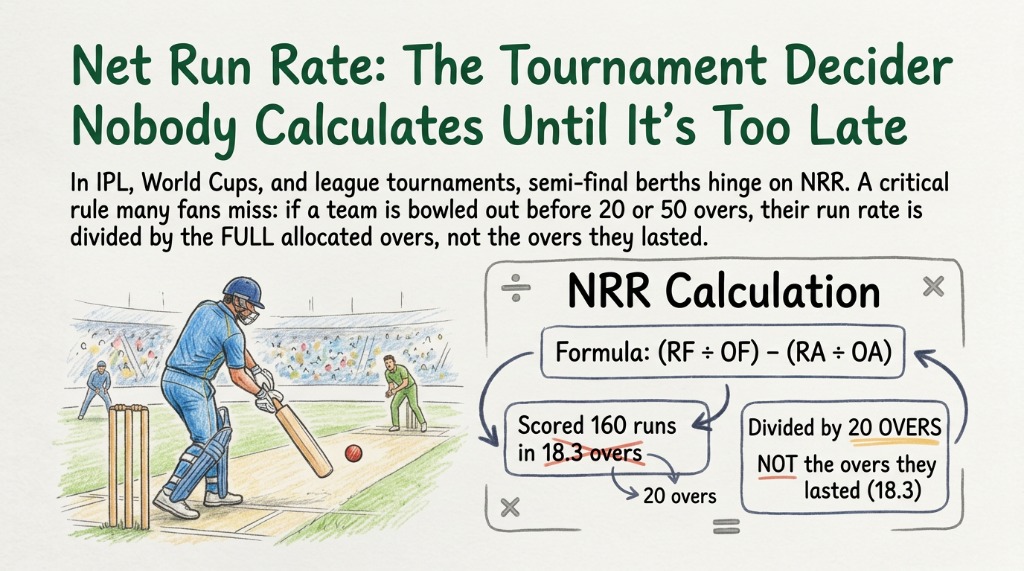
A team all out for 100 in 15 overs of a 20-over match is counted as 100 in 20 overs, a rate of 5.00, not 100 in 15, which would be 6.67. Fix: apply the full-quota rule to all-out innings. See the net run rate guide.
9. Rounding too early
For the two-match net run rate example, the true figure is +1.279. If you round the scoring rate (8.0286) to 8.0 and the conceding rate (6.75) to 6.8 before subtracting, you get +1.2, a visible error. Fix: keep full precision until the last step and round only the final answer.
10. Mixing time windows
A batter scores 48 in total, of which 30 came off the last 16 balls. Dividing 48 by 16 gives 300.00. The correct strike rate for those 16 balls is 30 ÷ 16 × 100 = 187.50. Fix: use the same start and end points for both the runs and the balls.
A habit that catches most of these
Write down the question before touching a calculator: what is being measured, over which balls, and whose runs? Then check that every number you plug in matches that description. If a result looks too good or too bad, change one input at a time and see which one moves the answer. If the problem persists, send us the figures and we will check them.
Practice questions with answers
Try these on your own first, then compare with the answers.
Question 1. A team scores 90 in 11.2 overs. What is the run rate, and what do you get if you treat 11.2 as a decimal?
Answer. 11.2 overs is 68 balls. 90 × 6 ÷ 68 = 7.94. Dividing by 11.2 gives 8.04, which is wrong.
Question 2. A batter makes 12 from 10 balls and 18 from 14 balls. What is the combined strike rate?
Answer. 30 from 24 balls: 125.00. The average of the two rates, 120.00 and 128.57, is 124.29, which is not the same.
Question 3. The opposition scored 143. A side is 90 for 2. How many runs does it need?
Answer. The target is 144, so it needs 144 − 90 = 54.
Check your own figures
Every calculator on this site shows the formula and a worked example, so you can compare your own working with the result.
Browse all calculatorsQuestions readers ask
What is the most common cricket calculation mistake?
Treating scorecard overs as decimals. Entering 8.3 overs as 8.3 instead of 51 balls produces errors in run rate, economy and net run rate.
Should I round during a calculation?
No. Keep full precision and round the final answer only. Early rounding can change the result noticeably, especially in net run rate.
How can I check an answer quickly?
Convert everything to balls, recompute with runs and balls only, and compare. For team totals, check that batters’ runs plus extras equal the score.
Where can I report a wrong result on this site?
Use the contact page and include the tool name, the values you entered and the result you expected.
How this guide was checked
Published by CricketCals. Every match, score and player in this guide is a fictional teaching example, so you can reproduce each answer from the figures shown. Calculations keep full precision until the final rounding. If a published scorecard or a competition rule disagrees with a figure here, the official record and the event's playing conditions take priority. You can send a correction with the figures and the rule you used.
- MCC Laws of Cricket: Laws 17 to 23 define overs, runs and extras.
- ICC playing conditions: Competition-specific rules for NRR, powerplays and targets.