Add spells in balls, then write the overs again
The dot in an overs figure separates complete overs from balls. This guide shows how to convert, add and subtract overs correctly so rates and totals come out right.
By CricketCals · Published 2 October 2026 · Updated 14 October 2026
Cricket writes overs with a dot, but the dot is not a decimal point. In 7.4 overs, the 4 counts balls, not tenths of an over. Once you understand that, nearly every confusing calculation involving overs, run rates and economy rates becomes straightforward.
This guide explains the notation, shows how to add and subtract overs without producing impossible values, and gives a few spreadsheet formulas for doing it in bulk.
What the dot means
The figure before the dot is the number of complete overs and the figure after it is the number of legal balls bowled in the over in progress. Because an over has six balls, the digit after the dot runs only from 0 to 5. After 7.5 comes 8.0, never 7.6.
Seven overs and four balls is 7 × 6 + 4 = 46 balls. As a true decimal duration, that is 46 ÷ 6 = 7.6667 overs. The two figures describe the same passage of play, but they cannot be used interchangeably in ordinary arithmetic. The scorecard notation is for reading, and balls or decimal overs are for calculating.
| Scorecard overs | Legal balls | Decimal overs |
|---|---|---|
| 0.5 | 5 | 0.8333 |
| 1.0 | 6 | 1.0000 |
| 8.3 | 51 | 8.5000 |
| 12.3 | 75 | 12.5000 |
| 16.4 | 100 | 16.6667 |
| 19.5 | 119 | 19.8333 |
| 20.0 | 120 | 20.0000 |
Adding spells
Add 3.4 and 2.5 overs. Ordinary addition gives 6.9, which is not a valid entry because the ball digit cannot reach 9. Convert each spell to balls first: 3.4 is 22 balls and 2.5 is 17 balls. The total is 39 balls. Divide by six: 6 complete overs with 3 balls left over, written 6.3.
The general method has three steps. Convert every figure to balls, add or subtract the balls, then convert back by dividing by six. The whole-number quotient is the overs and the remainder is the digit after the dot.
Overs remaining
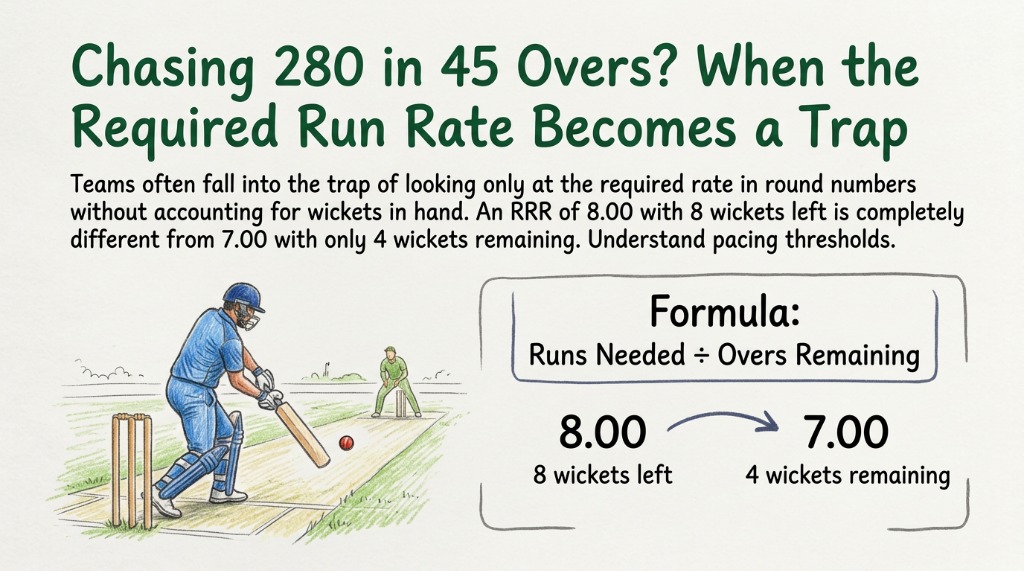
Subtraction works the same way. In a 20-over innings, after 14.5 overs the batting team has used 14 × 6 + 5 = 89 balls. The innings has 120 balls in total, so 120 − 89 = 31 balls remain. Divide by six: 5 overs and 1 ball, written 5.1.
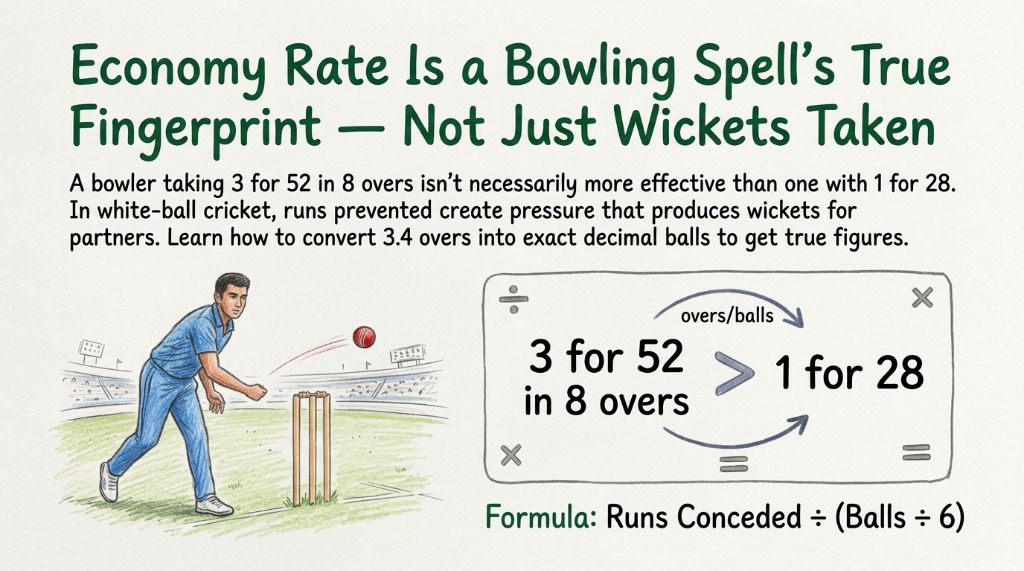
Doing this in decimals gives the wrong answer. 20 − 14.5 is 5.5, which would suggest five overs and five balls, a difference of four balls. This is the most common error when working out how many balls are left in a chase, as the required run rate guide shows.
Why rates need balls or decimal overs
Run rate is runs per over, so the denominator has to be a true number of overs. A team on 51 runs after 7.4 overs has bowled 46 balls, which is 7.6667 overs. The run rate is 51 × 6 ÷ 46 = 6.65. Dividing 51 by 7.4 would give 6.89, which overstates the rate because 7.4 is not a decimal.
The same warning applies to economy rate and to net run rate. Whenever a formula divides by overs, convert the scorecard figure first.
Doing it in a spreadsheet
If a cell A1 holds overs in scorecard notation, such as 7.4, the number of balls is:
=INT(A1)*6+ROUND((A1-INT(A1))*10,0)
The ROUND step guards against tiny floating-point errors, because 7.4 minus 7 is not stored as exactly 0.4. To convert balls in cell B1 back to scorecard notation:
=INT(B1/6)+MOD(B1,6)/10
For 46 balls this returns 7.4. Always store the raw ball count and format the overs only for display, so you never add scorecard figures together by mistake.
Exceptions and special cases
The six-ball over is the standard in modern professional cricket, but not every competition uses it. Overs of different lengths were used in some countries in the past, and the sets of five balls in The Hundred follow a different structure. The converter on this site assumes six-ball overs. If your match used a different convention, check the competition rules before using the figures.
Also remember that wides and no-balls are not legal deliveries. They do not advance the ball count, so the physical number of deliveries can exceed the number shown. An umpire’s miscount can change the real number of legal balls in an over, so the scorebook record is the authority in an actual match.
Practice questions with answers
Try these on your own first, then compare with the answers.
Question 1. How many balls is 12.4 overs?
Answer. 12 × 6 + 4 = 76 balls.
Question 2. A bowler delivers 2.5 overs in one spell and 4.3 in another. What are the total overs?
Answer. 17 + 27 = 44 balls, which is 7 overs and 2 balls: 7.2. Adding as decimals would give an invalid 6.8.
Question 3. After 38.2 overs of a 50-over innings, how many overs remain?
Answer. Balls used: 38 × 6 + 2 = 230. Remaining: 300 − 230 = 70 balls, which is 11.4 overs.
Check your own figures
Enter an overs figure such as 14.2 to see the balls bowled, the decimal equivalent and the balls remaining in a 20 or 50-over innings.
Open the Overs to Balls calculatorQuestions readers ask
Why is 16.67 not a valid overs entry?
Because 16.67 is a decimal rounding of 16 and four-sixths. The scorecard notation for the same passage is 16.4, which means 16 overs and 4 balls, or 100 balls.
Can the ball digit be 6?
No. After six legal balls the over is complete and the count moves to the next whole number. After 7.5 comes 8.0.
How many balls are in a 50-over innings?
300 balls. A 20-over innings has 120 and a Test day of 90 overs has 540.
Do wides add to the ball count?
No. A wide is not a legal delivery, so it does not advance the over. The batting side gets a run and the over still needs six legal balls.
How this guide was checked
Published by CricketCals. Every match, score and player in this guide is a fictional teaching example, so you can reproduce each answer from the figures shown. Calculations keep full precision until the final rounding. If a published scorecard or a competition rule disagrees with a figure here, the official record and the event's playing conditions take priority. You can send a correction with the figures and the rule you used.
- MCC Laws of Cricket: Law 17 defines the over as six balls and Laws 21 and 22 cover deliveries that do not count.
- ICC playing conditions: Event-specific over limits and conditions.