Check the runs column before judging a bowling spell
A bowler’s economy rate uses the runs charged to them, not the runs the team added. Here is how to read the analysis column, convert overs correctly and combine spells.
By CricketCals · Published 2 October 2026 · Updated 14 October 2026
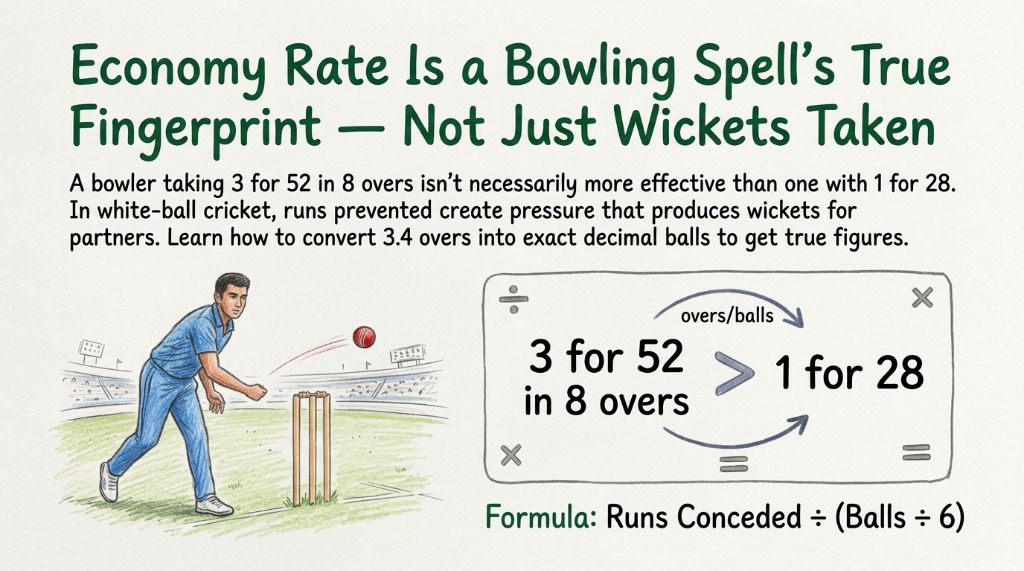
Economy rate is the average number of runs a bowler concedes per six-ball over. It is one of the first figures people check in a bowling analysis, and one of the easiest to get wrong. The usual mistakes are using the team's runs instead of the bowler's, and treating an entry like 5.3 overs as if it were a decimal.
This guide shows how to read the runs column correctly, how to handle part-overs, how to combine spells, and why a low economy rate is only part of a bowling story.
The formula and what goes into it
Economy rate = runs charged to the bowler × 6 ÷ legal balls bowled
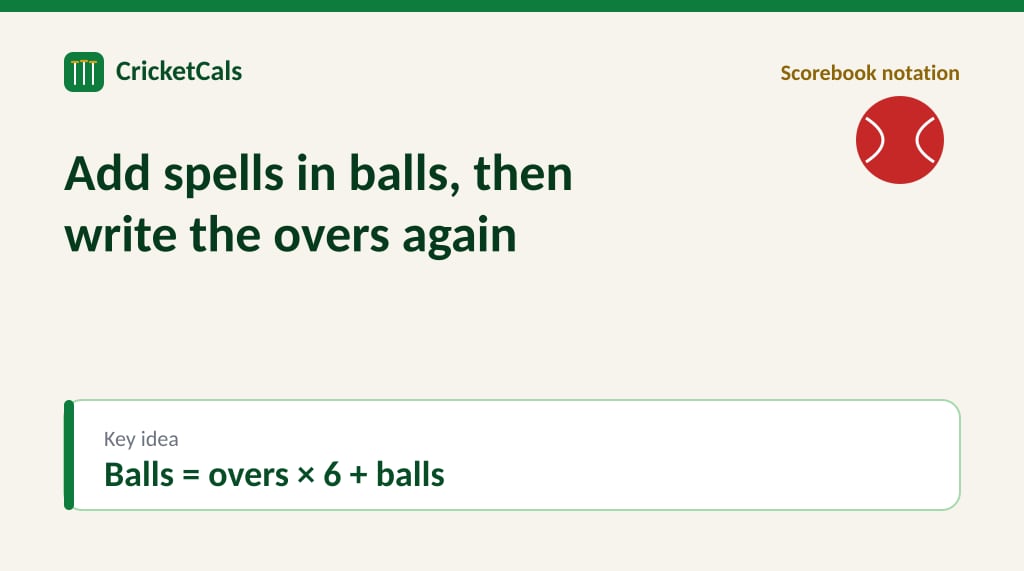
Working in balls avoids the decimal trap. Four overs and three balls is 27 legal deliveries, because 4 × 6 + 3 = 27. If those 27 balls cost 31 runs, the economy is 31 × 6 ÷ 27 = 6.89 runs per over.
The same result comes from dividing by decimal overs (27 ÷ 6 = 4.5), but only if you have converted first. Typing 4.3 into an ordinary division gives a different, wrong answer. The overs to balls guide covers the conversion in detail.
Team runs and bowler runs are different
Suppose the team adds 35 runs during a spell, but five of them are byes and leg-byes. Those five do not count against the bowler. If you use 35 as the economy input, the figure is overstated. The recorded bowling analysis shows the correct number: 30.
In standard scoring, wides and no-ball penalties are charged to the bowler, along with every run scored off the bat. Byes and leg-byes are not. The table below follows one fictional over, delivery by delivery.
| Delivery | What happened | Team runs added | Charged to bowler | Legal ball? |
|---|---|---|---|---|
| 1 | Single off the bat | 1 | 1 | Yes |
| 2 | Wide | 1 | 1 | No |
| 3 | Four off the bat | 4 | 4 | Yes |
| 4 | Two leg-byes | 2 | 0 | Yes |
| 5 | No-ball, two off the bat | 3 | 3 | No |
| 6 | Dot ball | 0 | 0 | Yes |
| 7 | Single off the bat | 1 | 1 | Yes |
| 8 | Dot ball | 0 | 0 | Yes |
| Total | 12 | 10 | 6 legal balls |
The scoreboard moved by 12, but the bowler's column moved by 10. If this bowler had 0 for 20 after two overs, their figures become 0 for 30 after three overs, an economy of 10.00. The extras guide explains why each type is charged the way it is.
Part-overs and unfinished spells
Take 30 runs conceded in 5.3 overs. The bowler has delivered 5 × 6 + 3 = 33 legal balls, so economy is 30 × 6 ÷ 33 = 5.45. Dividing 30 by 5.3 would give 5.66, which treats the 3 as three tenths of an over and overstates the rate.
An unfinished spell works the same way. A spell of 27 runs from 3.4 overs is 22 balls. Economy is 27 × 6 ÷ 22 = 7.36. Using 3.4 as a decimal would produce 7.94, a difference of more than half a run per over.
If a bowler is taken off mid-over, the next bowler completes it. Each bowler's analysis shows only the balls they delivered, so part-overs are common.
Combine spells by adding runs and balls
A bowler delivers 2 overs for 12 runs in the morning and 3.3 overs for 18 in the afternoon. The first spell is 12 balls and the second is 21, a total of 33 balls and 30 runs. The combined economy is 30 × 6 ÷ 33 = 5.45.
Do not average the two spell rates. Six runs an over and 5.14 an over averaged together give 5.57, which treats a 12-ball spell as equal to a 21-ball spell. Add the runs, add the balls, then divide. Keep full precision until the last step and round only the displayed answer.
What a single economy rate hides
Economy tells you how expensive a bowler was per over, not how valuable. Consider two fictional spells.
| Spell | Figures (O-M-R-W) | Economy |
|---|---|---|
| A | 4-0-24-1 | 6.00 |
| B | 4-0-30-3 | 7.50 |
Spell A is cheaper, and spell B took two more wickets. Which was better depends on the match. In a defence of a small total, wickets can matter more than saving runs. In the last overs of a flat-pitch run chase, restricting the batters may matter most. Bowling in the powerplay, when fielding restrictions apply, is a different task from bowling in the middle overs.
The notation O-M-R-W means overs, maidens, runs and wickets. A maiden is an over with no runs charged to the bowler, so an over containing only leg-byes can still be a maiden.
Practice questions with answers
Try these on your own first, then compare with the answers.
Question 1. A bowler concedes 29 runs in 3.2 overs. What is the economy rate?
Answer. 3.2 overs is 20 balls. 29 × 6 ÷ 20 = 8.70.
Question 2. The team adds 52 runs in a five-over spell, including 3 byes and 2 leg-byes. What is the bowler’s economy?
Answer. The bowler is charged 52 − 5 = 47 runs. 47 ÷ 5 = 9.40.
Question 3. A bowler has spells of 2 overs for 14 and 1.4 overs for 13. What is the combined economy?
Answer. Balls: 12 + 10 = 22. Runs: 27. 27 × 6 ÷ 22 = 7.36.
Check your own figures
Enter the runs charged to the bowler and the overs bowled in scorecard notation to get the economy rate to two decimal places.
Open the Bowling Economy calculatorQuestions readers ask
Are byes and leg-byes charged to the bowler?
No. Byes and leg-byes are added to the team total as extras but are not counted in the bowler's runs conceded. Wides and no-ball penalties are charged to the bowler.
Why is my economy different from the scorecard?
Check that you used the bowler's conceded runs, not the team runs, and that you entered overs in scorecard notation. A result such as 5.45 versus 5.66 usually means the overs were treated as a decimal.
Can I calculate economy before a ball is bowled?
No. With zero legal balls the rate is undefined. After one legal ball it can be calculated, but a single ball tells you very little.
Is a lower economy always better?
Not necessarily. Economy is runs per over, so it ignores wickets and the situation of the match. A more expensive spell that takes key wickets can be more valuable.
How this guide was checked
Published by CricketCals. Every match, score and player in this guide is a fictional teaching example, so you can reproduce each answer from the figures shown. Calculations keep full precision until the final rounding. If a published scorecard or a competition rule disagrees with a figure here, the official record and the event's playing conditions take priority. You can send a correction with the figures and the rule you used.
- MCC Laws of Cricket: Laws 17, 21, 22 and 23 cover the over, no-balls, wides, byes and leg-byes.
- ICC playing conditions: Event rules, including powerplay and over limits.