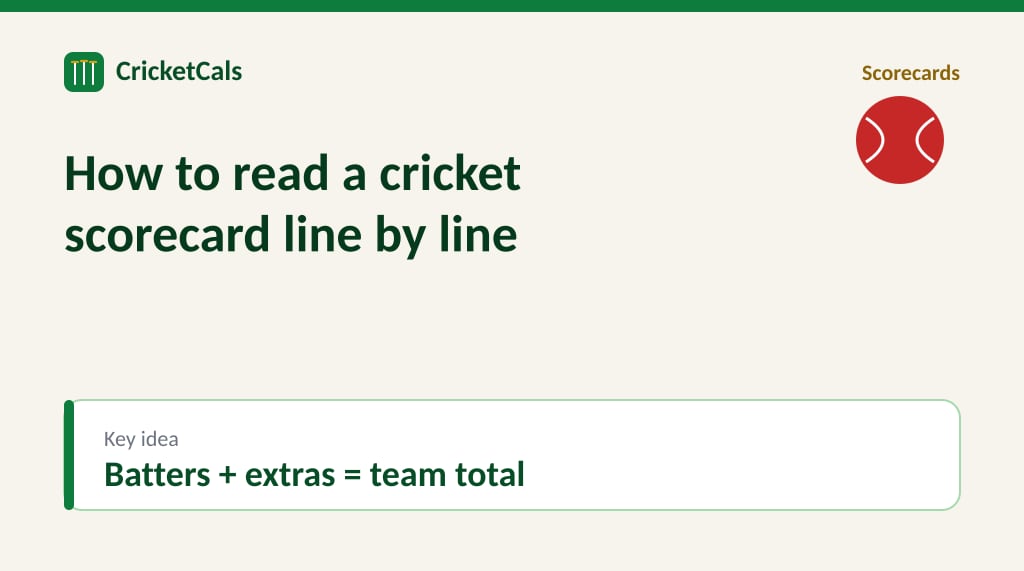
How to read a cricket scorecard line by line
A scorecard packs a whole innings into a few lines of shorthand. This guide decodes each column and shows how to check that the batting, extras and bowling figures all agree.
By CricketCals · Published 14 October 2026 · Updated 14 October 2026
A cricket scorecard looks dense at first, but it follows a small set of conventions. Every batter has a line that says how they got out, how many runs they scored, how many balls they faced and how many fours and sixes they hit. Every bowler has a line of overs, maidens, runs and wickets. The totals at the bottom must agree with the lines above.
This guide decodes a fictional T20 scorecard from top to bottom and shows the cross-checks that confirm every number.
The batting card
| Batter | How out | Runs | Balls | 4s | 6s | Strike rate |
|---|---|---|---|---|---|---|
| A. Rao | c Mehta b Khan | 28 | 21 | 3 | 1 | 133.33 |
| D. Patel | b Iqbal | 14 | 12 | 2 | 0 | 116.67 |
| S. Wright | lbw b Khan | 41 | 27 | 4 | 2 | 151.85 |
| I. Qureshi | not out | 52 | 30 | 5 | 3 | 173.33 |
| T. Hale | run out (Mehta) | 6 | 5 | 1 | 0 | 120.00 |
| R. Nair | not out | 9 | 5 | 1 | 0 | 180.00 |
The how out column reads left to right. "c Mehta b Khan" means caught by Mehta, bowled by Khan. "b Iqbal" is bowled. "lbw b Khan" is leg before wicket. "run out (Mehta)" names the fielder who made the run out, and no bowler is credited. "st" means stumped and "not out" means the batter was still at the crease when the innings ended. The strike rate in the last column is the runs divided by balls faced, times 100, as explained in the strike rate guide.
The 4s and 6s columns count boundaries hit off the bat. They are not counted in extras. A boundary that comes from byes or leg-byes is an extra.
Extras and the total
Below the batting lines sit the extras and the team total.
- Extras: 12 (b 1, lb 4, w 6, nb 1). Byes 1, leg-byes 4, wides 6 and no-balls 1.
- Batters’ runs: 28 + 14 + 41 + 52 + 6 + 9 = 150.
- Total: 150 + 12 = 162 for 4 in 20 overs.
The first cross-check is that batters’ runs plus extras equal the total. Another is that the number of wickets matches the number of dismissed batters: four batters are out, so the score is 162 for 4. The two not-out batters are still at the crease. Each type of extra is explained in the extras guide.
Fall of wickets
Fall of wickets: 1-35 (Rao), 2-58 (Patel), 3-103 (Wright), 4-139 (Hale). Each entry is the wicket number and the team score at that moment, with the dismissed batter in brackets. The partnerships are the differences: 35, 23, 45 and 36. The unbeaten stand between Qureshi and Nair is 162 − 139 = 23. Add all five and you get 35 + 23 + 45 + 36 + 23 = 162, the team total, as explained in the partnership guide.
The bowling card
| Bowler | Overs | Maidens | Runs | Wickets | Economy |
|---|---|---|---|---|---|
| Khan | 4 | 0 | 30 | 2 | 7.50 |
| Iqbal | 4 | 1 | 24 | 1 | 6.00 |
| Mehta | 4 | 0 | 35 | 0 | 8.75 |
| Sharma | 4 | 0 | 38 | 0 | 9.50 |
| Bose | 4 | 0 | 30 | 0 | 7.50 |
The bowlers’ runs add to 30 + 24 + 35 + 38 + 30 = 157, not 162. The difference of five is the byes (1) and leg-byes (4), which are not charged to any bowler. The wickets add to three, not four, because the run out is credited to a fielder and not to a bowler. Overs add to 20, which confirms every ball in the innings is accounted for. The Iqbal row shows a maiden: an over with no runs charged to the bowler.
Economy is runs per over, calculated for each row as runs × 6 ÷ balls, as in the economy guide.
The result line
A scorecard ends with the result. If the second team scored 158 for 7 in 20 overs, the first team won by 4 runs, because 162 − 158 = 4. If the chasing team had passed the target with wickets in hand, the result would be written as a win by that many wickets, and with balls to spare if the information is given. Rain-affected matches record the method used for the revised target, as in the DLS guide.
The overall team run rate for this innings is 162 ÷ 20 = 8.10.
A checklist for any scorecard
- Batters’ runs plus extras equal the team total.
- Dismissed batters equal wickets lost.
- Bowlers’ runs equal the total minus byes and leg-byes.
- Bowlers’ wickets equal wickets lost minus run outs and other non-bowler dismissals.
- Bowlers’ overs add up to the overs faced by the batting team.
- Fall-of-wicket differences add up to the team total.
If any check fails, look for a typing slip or a convention you have not applied, such as a run out or a penalty.
Practice questions with answers
Try these on your own first, then compare with the answers.
Question 1. Batters’ runs total 112 and the extras are b 2, lb 3, w 3, nb 1. What is the team total?
Answer. Extras are 9, so the total is 112 + 9 = 121.
Question 2. What do the bowlers’ runs add up to?
Answer. Byes and leg-byes are not charged to bowlers: 121 − 2 − 3 = 116.
Question 3. The fall of wickets reads 1-30, 2-77, 3-100. What are the partnerships?
Answer. 30, 47 and 23.
Check your own figures
Once you can read the columns, use the calculators to turn any scorecard row into a strike rate, an economy rate, a partnership or a run rate.
Browse all calculatorsQuestions readers ask
What do the letters c, b, lbw and st mean?
They stand for caught, bowled, leg before wicket and stumped. A run out lists the fielder, not the bowler.
Why do bowlers’ runs not add up to the team total?
Byes and leg-byes are in the team total but are not charged to the bowler. Subtract them from the total to match the bowling column.
What does a dash or an asterisk next to a score mean?
An asterisk after a score usually means the batter was not out. Some cards use a dash for statistics that cannot be calculated, such as an average with no dismissals.
Is the order of batters the batting order?
Usually yes. Batters are listed in the order they came to the crease, not in the order they were dismissed.
How this guide was checked
Published by CricketCals. Every match, score and player in this guide is a fictional teaching example, so you can reproduce each answer from the figures shown. Calculations keep full precision until the final rounding. If a published scorecard or a competition rule disagrees with a figure here, the official record and the event's playing conditions take priority. You can send a correction with the figures and the rule you used.
- MCC Laws of Cricket: Laws on dismissals, extras and the scoring of runs.
- ICC playing conditions: Match conditions and how results are recorded.