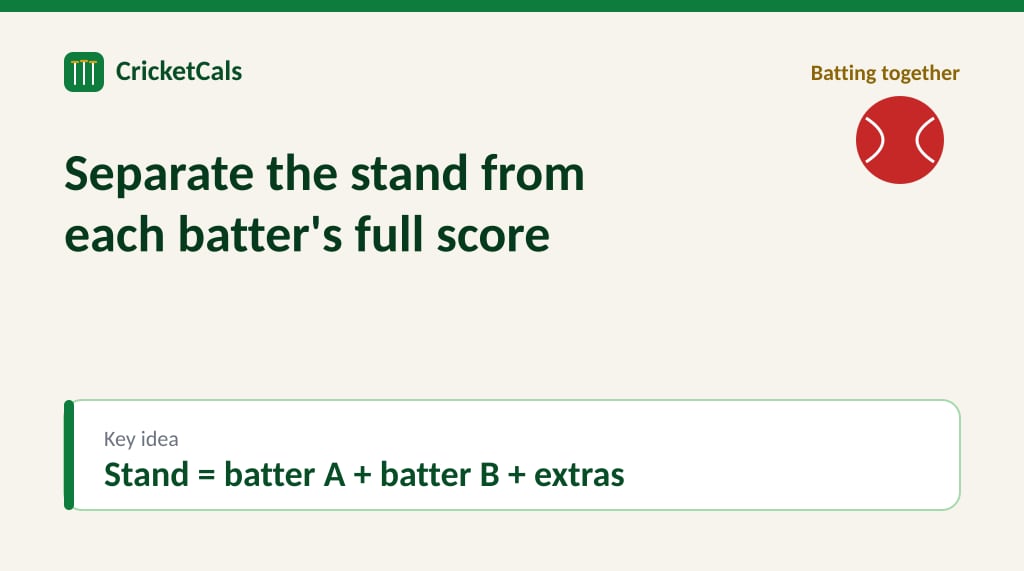
Separate the stand from each batter’s full score
A partnership is the runs added while two batters were together. It is not the sum of their innings totals. Here is the arithmetic, the fall-of-wickets shortcut and how extras fit in.
By CricketCals · Published 2 October 2026 · Updated 14 October 2026
A partnership begins when a particular pair is at the crease and ends when one of them is dismissed or the innings closes. The runs added in between belong to the pair, not to the batters’ individual scores. That sounds obvious, but a batter who was already on 24 when a new partner arrived has not contributed those 24 runs to the new stand.
This guide shows how to measure a stand from the team score, how to split it between the two batters and the extras, and how to read the fall-of-wickets line in a scorecard.
Measure the stand from the team score
The simplest way to measure a partnership is to subtract the team score when it started from the team score when it ended. Imagine the team is 52 for 2 when two batters come together. The next wicket falls at 109 for 3. The stand is 109 − 52 = 57.
This works regardless of how the runs were scored, because every run the team adds while the pair is together belongs to the partnership, including extras.
Split the stand between batters and extras
Now divide the 57. The established batter moved from 24 to 49 during the stand, a contribution of 25. The new batter scored 27. The remaining runs came from extras: 57 − 25 − 27 = 5.
Stand runs = batter A’s runs in the stand + batter B’s runs in the stand + extras
Using the full stand as the denominator, the shares are 25 ÷ 57 = 43.86%, 27 ÷ 57 = 47.37% and 5 ÷ 57 = 8.77%. They add to 100%. If you want to compare only the batters, drop the extras and use 52 as the denominator: 48.08% and 51.92%. Say clearly which version you are using, because the two answers differ.
Enter 25 and 27, not 49 and 27, in the partnership calculator. The calculator wants each batter’s contribution since the stand began, not their full innings score.
Reading the fall-of-wickets line
A scorecard lists the fall of wickets in a line such as 1-18, 2-52, 3-109, 4-111, 5-170. Each entry is the wicket number and the team score when it fell. The partnership for any wicket is the difference between that entry and the one before.
| Wicket | Team score at fall | Previous score | Partnership |
|---|---|---|---|
| 1st | 18 | 0 | 18 |
| 2nd | 52 | 18 | 34 |
| 3rd | 109 | 52 | 57 |
| 4th | 111 | 109 | 2 |
| 5th | 170 | 111 | 59 |
The five partnerships total 170, matching the final fall of wicket. If the innings ended at 178 for 5, the unbroken stand for the sixth wicket is 178 − 170 = 8. Every run in the innings is accounted for in some partnership, so checking that your partnerships add to the team total is a useful test.
The pace of a stand
A partnership has a run rate like any other passage of play. If the 57-run stand lasted 44 legal balls, its run rate is 57 × 6 ÷ 44 = 7.77 per over. That is the pair’s combined scoring speed. It says nothing about which batter was faster, which needs each batter’s balls faced, as described in the strike rate guide.
To find how many balls a stand lasted, subtract the over count at the start from the over count at the end after converting both to balls, using the overs to balls guide if you need a reminder of the notation.
Common traps
- Using full innings scores. A batter on 49 at the end of the stand contributed only the runs scored since the stand began.
- Mixing time windows. Innings extras include runs from earlier partnerships. Use only the extras added during the stand.
- Retirements. A batter who retires hurt and returns later creates a stand with a different partner. The fall-of-wickets line does not always show this, so the scorebook record of who was batting together matters.
- Treating a big stand as proof of quality. A large partnership tells you how many runs were added, not how fast or against what bowling.
Practice questions with answers
Try these on your own first, then compare with the answers.
Question 1. The fall of wickets reads 1-27, 2-74, 3-130. What are the three partnerships?
Answer. 27, 74 − 27 = 47, and 130 − 74 = 56.
Question 2. A stand begins at 61 for 2 and ends at 118 for 3. One batter contributed 31 and the other 20. How many extras were there?
Answer. The stand is 118 − 61 = 57. Extras are 57 − 31 − 20 = 6.
Question 3. In another 57-run stand the batters scored 30 and 21 with 6 extras. What are the shares of the whole stand?
Answer. 30 ÷ 57 = 52.63%, 21 ÷ 57 = 36.84% and extras 6 ÷ 57 = 10.53%. They add to 100%.
Check your own figures
Enter each batter’s runs during the stand and the extras to see the total, the share each contributed and the extras percentage.
Open the Partnership calculatorQuestions readers ask
Do extras count towards a partnership?
Yes. Every run the team scores while the pair is together belongs to the partnership, including byes, leg-byes, wides and no-ball penalties.
What if I only know each batter’s final score?
You need their scores when the stand began. Subtract those from their final scores to get each batter’s contribution to the stand.
Can a batter be in more than one partnership?
Yes. A batter who stays in while partners are dismissed is part of several consecutive partnerships, each measured separately.
Is the partnership percentage out of 100?
Only if you include extras. If you show the batters’ shares of bat runs alone, the two percentages add to 100%. With extras shown separately, all three add to 100%.
How this guide was checked
Published by CricketCals. Every match, score and player in this guide is a fictional teaching example, so you can reproduce each answer from the figures shown. Calculations keep full precision until the final rounding. If a published scorecard or a competition rule disagrees with a figure here, the official record and the event's playing conditions take priority. You can send a correction with the figures and the rule you used.
- MCC Laws of Cricket: Laws 18 to 23 cover how runs and extras are credited.
- ICC playing conditions: Retirement and substitution rules for the event you follow.