Bowling average, strike rate and economy: three numbers, one relationship
Bowlers are judged on average, strike rate and economy. They look like three separate statistics, but they are linked by one equation. This guide shows how to calculate each and how to use them together.
By CricketCals · Published 14 October 2026 · Updated 14 October 2026
A bowling analysis lists overs, maidens, runs and wickets. From those four numbers you can build three of the most quoted statistics in cricket: the bowling average, the bowling strike rate and the economy rate. They are not independent. Any two of them determine the third, which makes them a useful cross-check.
This guide defines each one, shows the equation that links them, and works through three fictional bowlers to show how the same spell can look good on one measure and poor on another.
Three definitions
Bowling average = runs conceded ÷ wickets taken
Bowling strike rate = balls bowled ÷ wickets taken
Economy rate = runs conceded × 6 ÷ balls bowled
Average tells you the cost of each wicket in runs. Strike rate tells you how often the bowler takes a wicket, measured in balls. Economy tells you how many runs the bowler concedes per over, whether or not wickets come.
Only wickets credited to the bowler count. A run out is not credited to the bowler, and neither is a retired-out dismissal. Runs conceded follow the usual rule: runs off the bat, wides and no-ball penalties are charged to the bowler, while byes and leg-byes are not. See the extras guide.
A worked spell
A bowler returns figures of 4-0-28-2, meaning four overs, no maidens, 28 runs and two wickets. Four overs is 24 balls.
- Average: 28 ÷ 2 = 14.00 runs per wicket
- Strike rate: 24 ÷ 2 = 12.0 balls per wicket
- Economy: 28 × 6 ÷ 24 = 7.00 runs per over
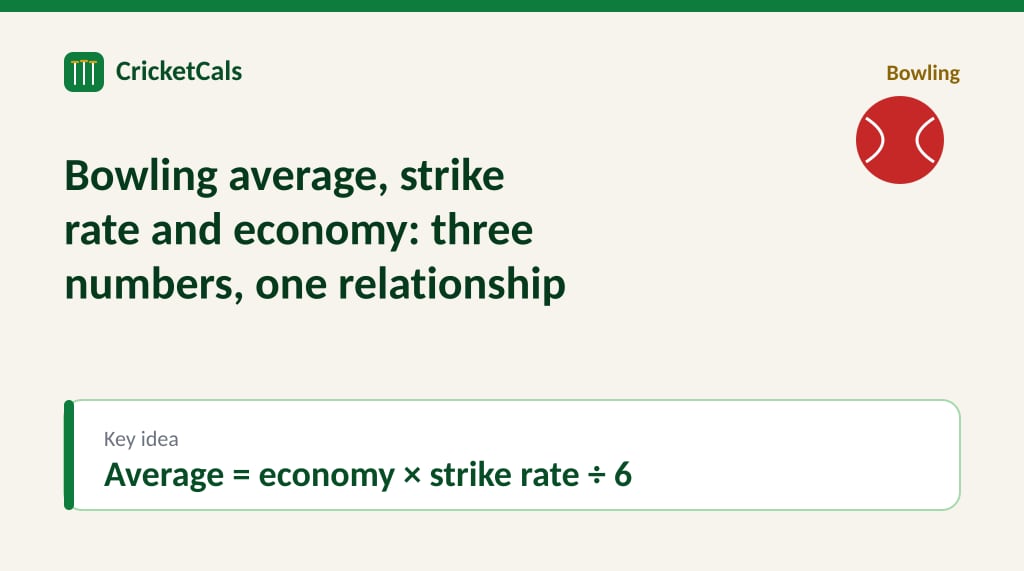
Now check the link: economy × strike rate ÷ 6 = 7.00 × 12 ÷ 6 = 14. That is the average. The relationship holds because average is runs per wicket, strike rate is balls per wicket and economy is runs per ball scaled to an over.
Average = economy × strike rate ÷ 6
Three bowlers, three stories
| Bowler | Figures (O-M-R-W) | Balls | Average | Strike rate | Economy |
|---|---|---|---|---|---|
| X | 8-1-40-2 | 48 | 20.00 | 24.0 | 5.00 |
| Y | 6-0-48-4 | 36 | 12.00 | 9.0 | 8.00 |
| Z | 10-0-60-2 | 60 | 30.00 | 30.0 | 6.00 |
Bowler X is economical but takes wickets slowly. Bowler Y is expensive per over but takes a wicket every nine balls, so each wicket costs only 12 runs. Bowler Z sits in the middle on economy but has the highest average and the slowest strike rate.
Which is best depends on the match. If the batting side has a big total to chase, a bowler like Y who attacks and takes wickets may be exactly what is needed even though the economy looks poor. If the side is defending a small total late in an innings, the economical bowler may matter more. No single number settles it, which is why analysts look at all three.
What each format emphasises
In Test cricket, where bowlers must take twenty wickets to win, strike rate and average carry the most weight and economy matters mainly for building pressure. In one-day and T20 cricket, economy is much more important because the opposition has a fixed number of overs, so restricting runs is itself a route to winning. A bowler with a poor average but a tight economy can be valuable in the middle overs of a T20 innings.
The same fictional figures read differently depending on the format. That is why comparisons across formats are rarely meaningful and why the formats guide separates them.
Edge cases and cautions
- No wickets. Average and strike rate are undefined when wickets are zero. Economy can still be calculated.
- Overs notation. Convert to balls first. 3.4 overs is 22 balls. See the overs guide.
- Small samples. A bowler with one wicket in a spell has an average equal to the runs conceded. Treat single-spell figures with caution.
- Combining spells. Add runs, balls and wickets across spells before dividing. Never average the averages.
Practice questions with answers
Try these on your own first, then compare with the answers.
Question 1. A bowler returns 10-2-42-3. What are the average, strike rate and economy?
Answer. Balls 60. Average 42 ÷ 3 = 14.00. Strike rate 60 ÷ 3 = 20.0. Economy 42 ÷ 10 = 4.20.
Question 2. A bowler returns 4-0-36-1. Calculate all three and check the relationship.
Answer. Average 36.00, strike rate 24.0, economy 36 × 6 ÷ 24 = 9.00. Check: 9.00 × 24 ÷ 6 = 36.
Question 3. A bowler has an economy of 6.50 and a strike rate of 18. What is the average?
Answer. 6.50 × 18 ÷ 6 = 19.50.
Check your own figures
Enter runs conceded, wickets and overs bowled to get the average, strike rate and economy together, and see how they connect.
Open the Bowling Average & Strike Rate calculatorQuestions readers ask
Is a lower bowling average better?
Yes. A lower average means fewer runs conceded per wicket. It should be read with sample size, format and conditions in mind.
Are run outs credited to the bowler?
No. A run out is not a bowler’s wicket, so it does not enter average or strike rate. The bowler’s runs and balls still count.
What is a good bowling strike rate?
Lower is better because it means fewer balls per wicket. What counts as good varies with format and era, so compare bowlers in the same conditions.
Can economy be low while average is high?
Yes. A bowler who concedes few runs per over but rarely takes wickets can have a low economy and a high average and strike rate.
How this guide was checked
Published by CricketCals. Every match, score and player in this guide is a fictional teaching example, so you can reproduce each answer from the figures shown. Calculations keep full precision until the final rounding. If a published scorecard or a competition rule disagrees with a figure here, the official record and the event's playing conditions take priority. You can send a correction with the figures and the rule you used.
- MCC Laws of Cricket: Laws on the over, extras and how dismissals are credited.
- ICC playing conditions: Bowling restrictions for the format you follow.