Projected score: how to estimate an innings total and why it needs a range
Scoreboards often show a projected total. It is a useful reference point but not a forecast. This guide shows how to calculate it, how to build a realistic range and what the figure leaves out.
By CricketCals · Published 14 October 2026 · Updated 14 October 2026
Broadcasters put a projected score on the screen as soon as an innings is a few overs old. It is quick to calculate and it is easy to read, which is why it is so common. It is also easy to over-trust. The projection extends the current pace to the end of the innings and says nothing about wickets, bowlers, conditions or the batting side’s plan.
This guide shows how to work it out by hand, then builds a more useful range of outcomes you can compare with a target.
The basic projection
Projected total = current score + remaining overs × assumed run rate
If the assumed rate is the current rate, the shortcut is current run rate × total overs. A team on 80 after 10 overs is scoring 8.00 an over. Over 20 overs that is 8.00 × 20 = 160. Using the long form, 80 + 10 × 8.00 = 160, the same answer.
Remember to convert overs to balls first. After 12.3 overs, 75 balls have been bowled and 45 remain, which is 7.5 overs. Entering the remaining overs as 7.3 would give a wrong total.
Build a range, not a single number
The assumed rate for the remaining overs is a choice, not a fact. Start with the same team on 80 after 10 overs and try four rates.
| Assumed rate for last 10 overs | Runs added | Projected total |
|---|---|---|
| 7.00 | 70 | 150 |
| 8.00 (current rate) | 80 | 160 |
| 9.00 | 90 | 170 |
| 10.00 | 100 | 180 |
A spread of 30 runs between the lowest and highest scenarios is realistic in T20 cricket. A single projection of 160 hides that. The wickets in hand decide which end of the range is more plausible. A team 80 for 1 has the resources to score at 10 an over at the end. A team 80 for 6 almost certainly does not.
A worked example with wickets
A side is 100 for 3 after 12.3 overs of a 20-over innings. Its current rate is 100 × 6 ÷ 75 = 8.00, and 7.5 overs remain.
- At the current rate: 100 + 7.5 × 8.00 = 160.
- If the rate rises by 1.5 an over, to 9.50: 100 + 7.5 × 9.50 = 171 (171.25 before rounding down to a whole-number score).
- If the rate rises to 10.00: 100 + 7.5 × 10.00 = 175.
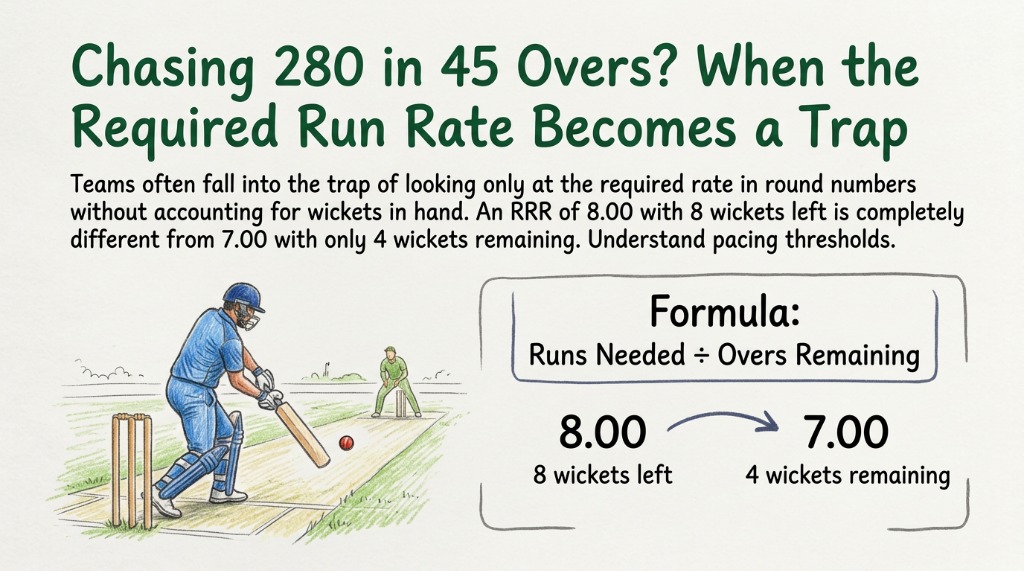
If the batting side wants to reach 180, it needs 80 more runs from 45 balls, a rate of 80 × 6 ÷ 45 = 10.67 per over. That is the figure to compare with what the batters believe they can do. This is the same arithmetic as the required run rate in a chase, as shown in the required run rate guide.
Why straight-line projections go wrong
- Phases differ. The last five overs are usually scored faster than the middle overs, so a straight line underestimates a side with wickets in hand. See the phase guide.
- Wickets are ignored. The formula treats a side on 100 for 1 and 100 for 6 as the same.
- Conditions change. A new bowler, a change of ball or dew can alter the pace.
- The target is unknown. In the first innings, nobody knows what total is enough, so a projection by itself does not say whether a side is ahead.
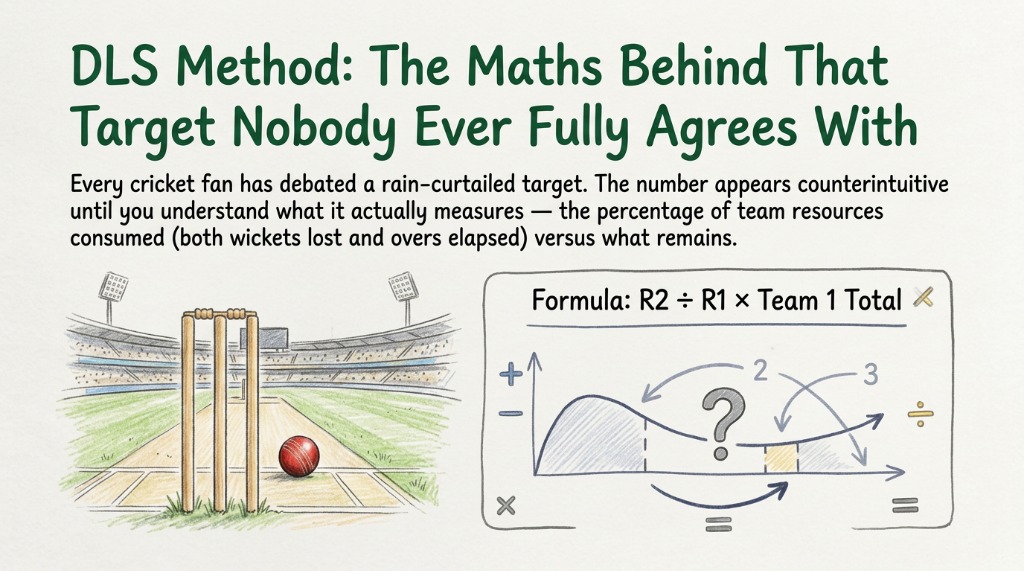
Rain-adjusted methods such as DLS address the wickets problem by assigning a value to wickets in hand. This is the idea behind the DLS guide. Even there, the resource percentages come from tables, not from the current run rate.
Using a projection sensibly
Treat a projected total as a prompt. Compare it with a reasonable par score for the venue, then ask what rate the batting side needs for the remaining overs to reach it. If the answer is unrealistic, the side is behind. If it is easy, the side is ahead. Recalculate after every over or two, and prefer the range to the single number.
Practice questions with answers
Try these on your own first, then compare with the answers.
Question 1. A side is 60 for 1 after 8 overs of a 20-over innings. What is the simple projected total?
Answer. Current rate 60 ÷ 8 = 7.50. Over 20 overs: 7.50 × 20 = 150.
Question 2. A side is 140 for 4 after 15 overs. Build a range using 8, 9, 10 and 11 an over for the last five.
Answer. 140 + 5 × rate gives 180, 185, 190 and 195.
Question 3. The same side as question 1 wants to reach 200. What rate does it need from 60 for 1 after 8 overs?
Answer. Runs needed 140 from 72 balls: 140 × 6 ÷ 72 = 11.67 per over.
Check your own figures
Enter the current score and the overs faced to get the current run rate, then try different rates for the remaining overs to build your own range.
Open the Run Rate calculatorQuestions readers ask
Is the projected score the same as the required run rate?
No. A projection extends the current pace to estimate a total. A required rate is calculated from a known target and says how fast the batters must score to reach it.
Why does my projected score differ from the TV graphic?
Broadcasters often use their own models that include wickets and phase-based scoring. A simple projection only uses the current run rate.
How do I project after a rain interruption?
Use the revised target and overs announced by the officials, then calculate the required rate. A simple projection does not account for the reduction.
Should I project from the first few overs?
Be cautious. A small number of balls makes the current rate unstable. A projection after two overs is mostly noise.
How this guide was checked
Published by CricketCals. Every match, score and player in this guide is a fictional teaching example, so you can reproduce each answer from the figures shown. Calculations keep full precision until the final rounding. If a published scorecard or a competition rule disagrees with a figure here, the official record and the event's playing conditions take priority. You can send a correction with the figures and the rule you used.
- ICC: Duckworth-Lewis-Stern: How resource-based methods value overs and wickets.
- MCC Laws of Cricket: Law 17 defines the over used to count balls remaining.