Margin of victory: runs, wickets and balls to spare
A result such as "won by 6 wickets" hides two numbers: the wickets in hand and the balls to spare. Here are the formulas behind every margin, how they feed net run rate, and a calculator to check your own match.
By CricketCals · Published 6 November 2026 · Updated 6 November 2026
A scoreboard result says "won by 25 runs" or "won by 6 wickets with 20 balls to spare". Those phrases look like simple headlines, but each one is the output of a small formula, and the formula you use depends on which team batted second. Runs, wickets and balls are three different currencies, and a result in one cannot be compared with a result in another by eye.
This guide sets out exactly how each margin is calculated, shows how a margin turns into a net run rate contribution, and gives you a calculator that takes a match scorecard and returns the margin and the NRR effect for both teams.
How margins are stated
Cricket reports a win differently depending on the batting order, in a standard eleven-a-side match.
- The team batting first wins. The margin is in runs: the first-innings total minus the second-innings total. The chasing side was all out or used all its overs and came up short.
- The team batting second wins. The margin is in wickets: the wickets the side still had in hand, which is ten minus the wickets lost. Reports often add the balls remaining.
- Scores level. If the chasing side finishes with exactly the first-innings total and has no overs or wickets left, the match is tied. The competition then applies its own tie-break, such as a Super Over.
- Rain-affected matches. After a revised target, the margin is measured against the revised target or par score, and the report names the method used. This guide covers uninterrupted matches only.
A win by wickets says nothing about how many runs the winners had in hand over the target. A win by runs says nothing about how many wickets or balls the losers had left. That is why the three kinds of margin do not line up on one scale.
The formulas
Runs margin = first-innings total − second-innings total (team batting first wins)
Wickets margin = 10 − wickets lost by the chasing side (chasing side wins)
Balls remaining = overs per innings × 6 − balls used by the chasing side
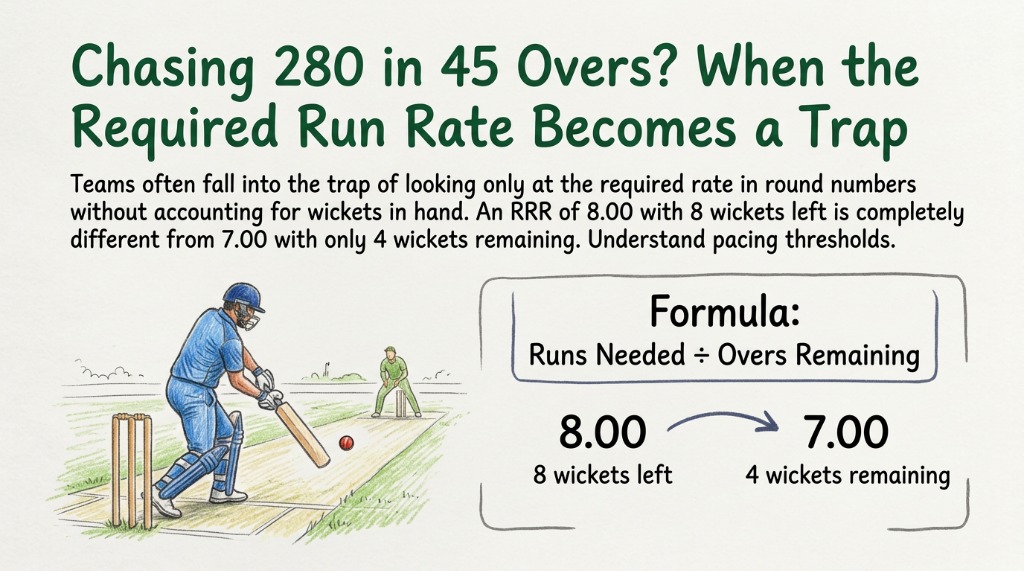
Chase succeeds when second-innings runs ≥ first-innings total + 1
The last line is the target rule. If the first team scored 168, the chasing side needs 169. Reaching 168 only levels the scores.
| Item | Working | Result |
|---|---|---|
| First-innings total | given | 168 |
| Target | 168 + 1 | 169 |
| Chasing score | 169 for 4 in 16.4 overs | 169 |
| Wickets margin | 10 − 4 | 6 wickets |
| Balls used | 16 × 6 + 4 | 100 |
| Balls remaining | 20 × 6 − 100 | 20 (3.2 overs) |
The headline would read "won by 6 wickets with 20 balls remaining". Always convert overs to balls before subtracting, as the overs guide explains. Subtracting 16.4 from 20 as decimals would give 3.6, which is wrong.
Check any match with the margin calculator
Enter the first-innings total, the chasing team’s runs, wickets lost and overs used. The tool returns the result, the margin, the balls remaining and the net run rate each team gains or loses from this one match.
Runs scored by the team that batted first.
Runs scored by the chasing team.
Wickets that fell in the second innings, 0 to 10.
Scorecard notation: 16.4 means 16 overs and 4 balls.
20 for T20, 50 for one-day cricket.
This tool covers uninterrupted matches with the same overs quota in both innings. It does not fetch live scores.
Three worked results
| Match | Scores | Result | Balls remaining | Winner’s NRR from this match |
|---|---|---|---|---|
| T20 chase | 168 v 169 for 4 in 16.4 overs | Chasing team wins by 6 wickets | 20 | +1.740 |
| T20 defence | 168 v 143 for 9 in 20 overs | First team wins by 25 runs | Not applicable | +1.250 |
| One-day chase | 280 for 6 v 281 for 3 in 44.2 overs | Chasing team wins by 7 wickets | 34 (5.4 overs) | +0.738 |
The one-day chase used 44 × 6 + 2 = 266 balls out of 300, leaving 34, which is 5 overs and 4 balls. The third column is the figure most match reports quote. The last column is what the margin is worth in net run rate, which the next section derives.
How a margin feeds net run rate
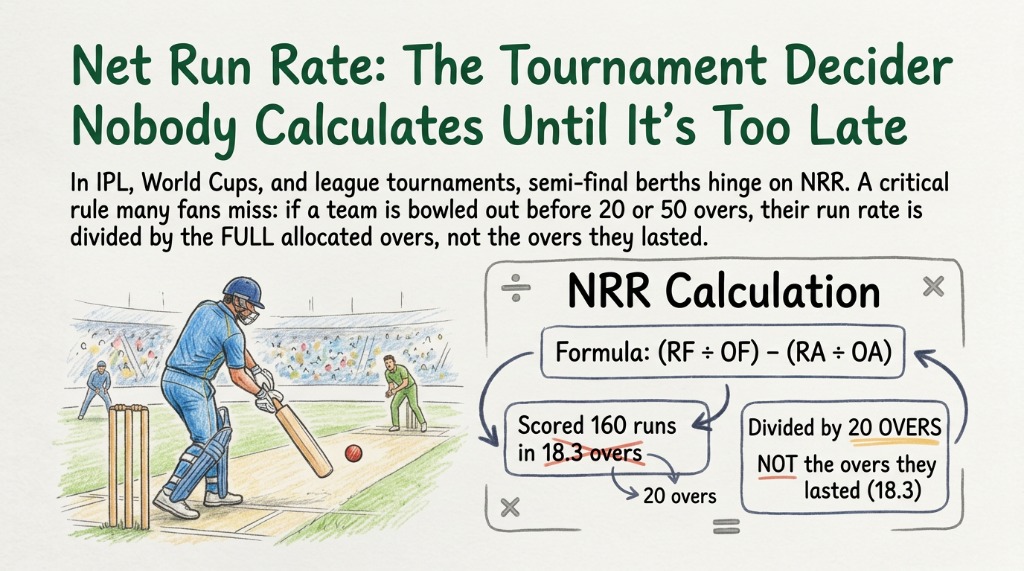
Net run rate for one match depends on how the overs are counted. The team batting first always counts the full quota. The chasing team counts the balls it actually used if it won, and the full quota if it lost, because it was then all out or used all its overs. That gives two short formulas.
Chasing winner’s match NRR = 6 × runs ÷ balls used − first-innings total ÷ overs per innings
First-batting winner’s match NRR = (first-innings total − second-innings total) ÷ overs per innings
Apply the first to the 169 for 4 chase: 6 × 169 ÷ 100 = 10.14, and 168 ÷ 20 = 8.40, so the match NRR is 10.14 − 8.40 = +1.740. The losing side gets exactly the same figure with the opposite sign, −1.740. Apply the second to the 25-run defence: (168 − 143) ÷ 20 = +1.250.
Balls to spare matter a great deal, and not in a straight line. Keep the 169-run target and change only how long the chase takes.
| Balls used | Overs | Chasing scoring rate | Chaser’s match NRR |
|---|---|---|---|
| 120 | 20.0 | 8.450 | +0.050 |
| 108 | 18.0 | 9.389 | +0.989 |
| 100 | 16.4 | 10.140 | +1.740 |
| 90 | 15.0 | 11.267 | +2.867 |
| 80 | 13.2 | 12.675 | +4.275 |
Winning off the last ball earns almost nothing (+0.050). Saving the first 12 balls is worth about 0.94 of NRR, and each further saving is worth more than the last because the denominator keeps shrinking. In a tournament that is decided on NRR, a fast chase can be worth more than a big defence. The net run rate guide shows how single-match figures combine into the tournament total.
Comparing margins fairly
Is winning by 25 runs bigger than winning by 6 wickets? On the face of it you cannot say, because the units differ. Two practical ways to compare them:
- Convert both to NRR. In the examples above, the 25-run win is worth +1.250 and the 6-wicket win is worth +1.740 on a 20-over scale. That is only a measure of net run rate value, not of how well the teams played.
- Compare resources, not results. A chase that ends with 20 balls and 6 wickets in hand left a lot unused. A chase that ends with 0 balls and 1 wicket in hand was a close finish even if the headline says "won by 1 wicket".
Neither method rates the quality of the play. A tough pitch can make a six-wicket win very hard to achieve, while a flat pitch can make a 25-run win look routine.
Edge cases
- Winning off the last ball. Balls remaining is 0, so the match NRR contribution is only the difference between the two scoring rates.
- Ties and Super Overs. Treatment varies by competition. Some leave Super Overs out of NRR entirely. Check the event regulations.
- Revised targets. After rain, a margin is measured against the revised target, and NRR adjustments follow competition rules. See the DLS guide.
- No result. Abandoned matches have no margin, and many competitions leave them out of NRR.
- Fewer than eleven players. The wickets margin then follows the competition’s convention, so check its regulations.
Common mistakes
- Reporting wickets lost as the margin. A chasing side that loses 4 wickets and wins has won by 6, not by 4.
- Using 11 instead of 10 in the wickets margin.
- Subtracting overs as decimals when finding balls remaining.
- Counting only the overs actually used for a chasing side that lost. For NRR, a losing chase counts the full quota.
- Using the first-innings total instead of the target. A chase needs one more run than the first-innings total.
- Comparing NRR contributions from matches with different overs quotas.
Practice questions with answers
Try these on your own first, then compare with the answers.
Question 1. The first team scores 150. The chasing team reaches 152 for 5 in 17.3 overs of a 20-over match. What is the margin, how many balls remain and what is the chaser’s match NRR?
Answer. Wickets margin 10 − 5 = 5 wickets. Balls used 17 × 6 + 3 = 105, so balls remaining are 120 − 105 = 15 (2.3 overs). Match NRR = 6 × 152 ÷ 105 − 150 ÷ 20 = 8.686 − 7.500 = +1.186.
Question 2. The first team scores 180. The chasing team is all out for 151 in 19.2 overs. What is the margin and each team’s match NRR?
Answer. Runs margin 180 − 151 = 29 runs. Both innings count as 20 overs, so the first team’s NRR is 29 ÷ 20 = +1.450 and the second team’s is −1.450.
Question 3. Scores are 160 and 160 for 9 after 20 overs. What is the result?
Answer. The scores are level and the chasing side has used all its overs, so the match is tied before any tie-break. The target was 161.
Check your own figures
Once you know each match margin, add the matches in the net run rate calculator to see the aggregate NRR for a whole stage of a tournament.
Open the Net Run Rate calculatorQuestions readers ask
Why is a win by wickets counted as 10 minus wickets lost?
Because a team has ten wickets to lose before it is all out in an eleven-a-side match. The wickets still standing when the target is reached are the wickets in hand.
Does a bigger margin always mean a better NRR?
Not always. A win by runs adds (margin ÷ overs) to NRR. A win by wickets adds more the sooner the chase finishes. A narrow win that finishes quickly can add as much as a comfortable defence.
What counts as balls remaining?
The overs quota in balls minus the balls the chasing side used. For a 20-over innings, that is 120 minus the balls used.
Why does the losing chasing team count the full quota?
Because it was either all out or used all its overs. NRR rules count the full overs quota for all-out innings, which stops a side improving its rate by collapsing quickly.
Does the calculator handle rain-affected matches?
No. It covers uninterrupted matches. For revised targets and overs, use the figures announced by the officials and the competition’s NRR rules.
How this guide was checked
Published by CricketCals. Every match, score and player in this guide is a fictional teaching example, so you can reproduce each answer from the figures shown. Calculations keep full precision until the final rounding. If a published scorecard or a competition rule disagrees with a figure here, the official record and the event's playing conditions take priority. You can send a correction with the figures and the rule you used.
- MCC Laws of Cricket: Laws on the result of a match and how runs are scored.
- ICC playing conditions: Net run rate, tie-break and revised-target provisions for ICC events.