Points table maths: wins needed, maximum points and the qualification line
Before net run rate matters, points decide who is still in the race. Here are the formulas for maximum possible points, wins needed and defeats a team can afford, with a six-team worked example and a calculator.
By CricketCals · Published 24 November 2026 · Updated 24 November 2026
Most league tables are decided in two stages. First comes points: a fixed number for every win, tie or no-result. Only when teams finish level on points does net run rate separate them. Supporters talk about the second stage far more than the first, yet the first stage is simple arithmetic that tells you what a team still needs to do.
This guide gives the formulas for points, maximum possible points, wins needed and defeats a team can afford. It works through a six-team table, shows where the simple method stops being reliable and includes a calculator that takes a team’s position and returns what it needs.
How league points are awarded
Many cricket leagues use the same basic scheme, but you should always confirm the one used by your competition.
- Win: 2 points.
- Tie or no-result: 1 point each, in many competitions.
- Defeat: 0 points.
Some competitions award bonus points, use a different value for a win, or treat a tied match differently, for example by deciding it with a Super Over. Because of this, every formula below uses w for the points awarded per win. Replace it with your competition’s figure. When two teams are level on points, rules usually separate them with net run rate, and some add other tie-breaks first, such as head-to-head results. The playing conditions of the event are the authority.
The formulas
Points = w × wins + 1 × (ties + no-results)
Matches left = matches in the league stage − matches played
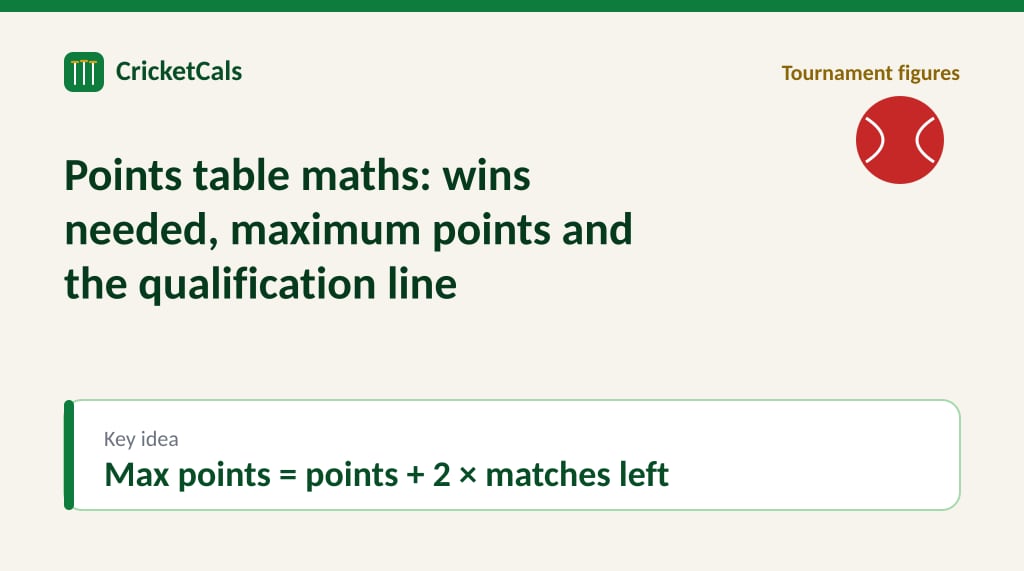
Maximum possible points = current points + w × matches left
Points still needed = target points − current points
Wins needed (wins only) = points still needed ÷ w, rounded up
Defeats you can afford = matches left − wins needed
Share of points won = points ÷ (w × matches played) × 100
Rounding up matters. If a team needs 5 more points and a win is worth 2, two wins give only 4, so it needs three wins, which is 6 points. A team can only be sure of a target if the wins needed do not exceed the matches left. The last formula is useful when teams have played different numbers of matches, because it compares points as a share of what was available.
Try it with your own table
Enter a team’s matches played, the matches in the league stage, its points and the target. The tool works out the maximum possible points, the wins needed and the defeats the team can afford.
League-stage matches completed so far.
Total league matches each team plays.
Points on the table now.
The total you want to reach, such as an expected qualification line.
Usually 2. Use your competition’s figure.
The tool works from the figures you enter, counts wins only and ignores other teams’ results. It does not fetch live tables.
A six-team table
| Team | Played | Won | Lost | No result | Points | Matches left | Maximum possible |
|---|---|---|---|---|---|---|---|
| A | 9 | 7 | 2 | 0 | 14 | 5 | 24 |
| B | 9 | 6 | 3 | 0 | 12 | 5 | 22 |
| C | 9 | 5 | 3 | 1 | 11 | 5 | 21 |
| D | 10 | 4 | 6 | 0 | 8 | 4 | 16 |
| E | 10 | 3 | 6 | 1 | 7 | 4 | 15 |
| F | 9 | 2 | 7 | 0 | 4 | 5 | 14 |
Team C has 2 × 5 + 1 = 11 points from 5 wins and 1 no-result. With 5 matches left, its maximum is 11 + 2 × 5 = 21. The table is internally consistent: the six teams have 27 wins and 27 defeats between them, and the 56 matches played are 28 real matches counted from both sides.
Suppose the qualification line is expected to be 16 points. Teams A, B, C and D can still reach 16. Team E tops out at 15 and team F at 14, so neither can reach 16. That does not mean they are out of the competition, because the line itself may fall. It means they cannot reach that particular number.
What a team still needs
Take team C and a target of 16. It needs 16 − 11 = 5 points, so wins needed = 5 ÷ 2 = 2.5, rounded up to 3 wins. With 5 matches left it can afford 5 − 3 = 2 defeats. It must win 3 ÷ 5 = 60% of its remaining matches.
Now change the target to 18. Points needed are 7, wins needed are 7 ÷ 2 = 3.5, rounded up to 4, and the team can afford only 1 defeat. Each extra two points of target costs about one more win, and that win comes straight out of the defeats the team can afford.
A mix of results can lower the number of outright wins. Team C could reach 16 with 2 wins and 1 no-result (2 × 2 + 1 = 5 points). The wins-only figure is therefore the safe, conservative one. The calculator reports wins-only for exactly that reason.
When teams have played different numbers of matches
In the table above, teams D and E have played 10 matches and the rest 9, so raw points are not a fair comparison. Share of points won divides points by the points available, w × matches played.
| Team | Points | Points available (2 × played) | Share of points won |
|---|---|---|---|
| A | 14 | 18 | 77.78% |
| B | 12 | 18 | 66.67% |
| C | 11 | 18 | 61.11% |
| D | 8 | 20 | 40.00% |
| E | 7 | 20 | 35.00% |
| F | 4 | 18 | 22.22% |
The ordering by share matches the ordering by points here, but when one team has played two more matches than another, the share can change who looks ahead. Treat it as a way to compare form, not as the official ranking, which always uses the competition’s own table.
Why the simple method has limits
Maximum possible points tells you whether a target is reachable. It does not tell you whether a team will qualify.
- The line moves. The qualification line depends on how all the teams finish. A team with a maximum of 15 can still qualify if the line turns out to be 14.
- Matches between contenders. When two teams that are chasing the same line play each other, one of them gains points and the other does not. Both cannot reach their maximum.
- Ties on points. Net run rate decides, and a team’s margin in its remaining matches affects it. See the margin of victory guide for how a single result changes NRR.
- Elimination. A team is mathematically eliminated only when no combination of results can put it in a qualifying position. Checking that requires all remaining fixtures, not a single team’s arithmetic.
The right reading of this guide’s numbers is therefore: wins needed is the minimum a team must achieve, and failing to reach it rules the target out, but reaching it does not guarantee qualification.
Common mistakes
- Using 2 points per win when the competition uses a different figure.
- Forgetting to round the wins needed up. Needing 5 points is 3 wins, not 2.5.
- Counting matches left from the fixture list instead of the league stage total. Playoff matches are separate.
- Assuming a team that cannot reach one target is eliminated.
- Comparing raw points for teams that have played different numbers of matches.
- Ignoring net run rate when teams can finish level on points.
Practice questions with answers
Try these on your own first, then compare with the answers.
Question 1. A team has played 8 of 14 league matches and has 10 points, with 2 points per win. What is its maximum, and how many wins does it need to reach 18 points?
Answer. Matches left are 14 − 8 = 6, so the maximum is 10 + 2 × 6 = 22. Points needed are 18 − 10 = 8, so wins needed are 8 ÷ 2 = 4, and the team can afford 6 − 4 = 2 defeats.
Question 2. A team has 6 wins and 2 no-results. How many points does it have?
Answer. 2 × 6 + 2 = 14 points.
Question 3. A team has played 12 of 14 matches and has 12 points. Can it reach 16? Can it reach 18?
Answer. Matches left are 2. To reach 16 it needs 4 points, so 2 wins, which means it can afford 0 defeats. To reach 18 it needs 6 points, so 3 wins, but only 2 matches are left. The maximum is 12 + 4 = 16, so 18 is out of reach.
Check your own figures
Points get a team to the line and net run rate separates teams that finish level. Use the net run rate calculator for the second step.
Open the Net Run Rate calculatorQuestions readers ask
How many points is a win worth?
Many cricket leagues award 2 points for a win and 1 point each for a tie or no-result, but competitions differ. Use your event’s figure in the points-per-win box.
Why do I round wins needed up?
Because a partial win does not exist. If a team needs 5 points and each win gives 2, two wins give only 4, so three wins are needed.
Does maximum possible points mean a team can still qualify?
Not necessarily. It only shows whether a target total is reachable. Qualification depends on where the line falls and how other teams finish.
What happens when teams finish level on points?
Rules usually use net run rate next, sometimes after other tie-breaks such as head-to-head results. Check the competition regulations.
Does the calculator include ties and no-results?
It counts wins only, so the answer is conservative. A tie or no-result earns fewer points, but a mix of results can reach the same total with fewer wins.
How this guide was checked
Published by CricketCals. Every match, score and player in this guide is a fictional teaching example, so you can reproduce each answer from the figures shown. Calculations keep full precision until the final rounding. If a published scorecard or a competition rule disagrees with a figure here, the official record and the event's playing conditions take priority. You can send a correction with the figures and the rule you used.
- ICC playing conditions: Competition points systems and tie-break rules for ICC events.
- MCC Laws of Cricket: Laws governing how a match result is determined.